
 •
•6yr ago
Looking for creative ways to market our app outside of social media, thoughts?
 •
•23d ago
How much knowledge walks out the door when someone leaves?
 •
•3yr ago
👋 Rajesh, DevOps turned founder here, I launched Humalect today - AMA
 •
•6mo ago
Post your product in one sentence — I’ll give blunt clarity feedback
Building something useful is hard. Explaining it clearly can be just as hard.
I ve noticed a lot of products seem solid, but the value isn t immediately obvious from the first sentence, screenshot, or landing page.
 •
•4yr ago
[ChangeLog] August 25th, 2022 Release Notes
This one goes out to all our makers! We ve been hard at work finding ways to make Product Hunt a better place for makers to launch and continue sharing their product journey. To do that we created some resources to help make the most of your launch, and built an Add-ons tab in Product Hubs to help users discover all of the plugins, extensions, companions, templates, and more that complement your products.
- Launch Guide In an effort to help makers feel more prepared for launch day, we hosted our first-ever How to launch on Product Hunt webinar this month, and also published a Launch Guide to make it easier than ever to find everything (seriously, everything) you need to know about launching in one place.
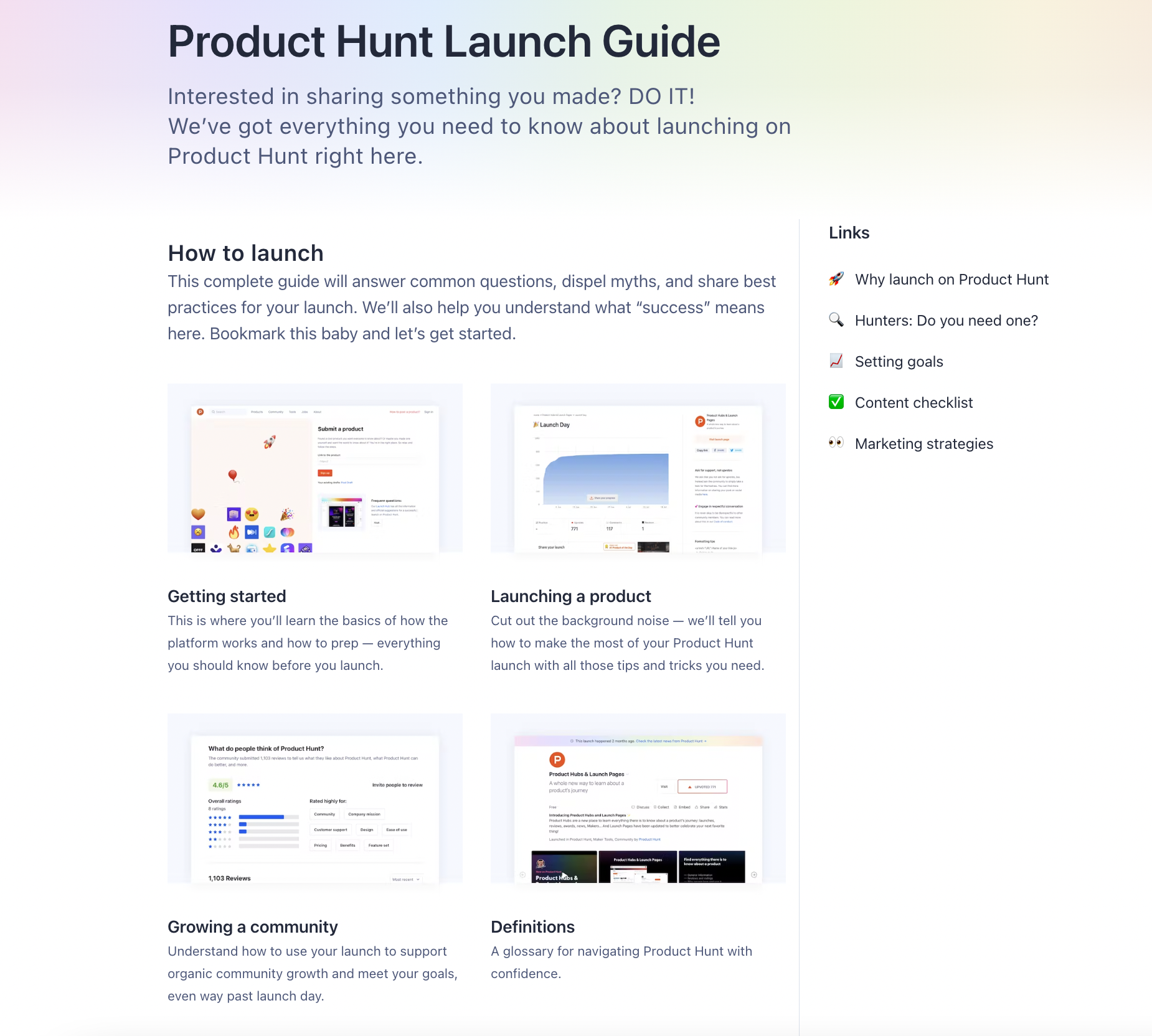
- Case studies In addition to the step-by-step playbook for pre-launch through post-launch, we ve included a few stories from other makers who have had successful launches on Product Hunt. Check out stories from Framer, Notion, and Loom founders to learn more about their experiences.
 •
•3yr ago
How would you...
 •
•5mo ago
Which business idea do you think was so ridiculous that it feels absurd how much money it made?
I don t mean this in a disrespectful way or anything like that, but throughout my life, I ve come across (and I m sure you have too) several products whose actual usefulness wasn t exactly impressive, but their creators still made a huge amount of money.
For me, for example, it was:
Fidget spinners (2017). At the peak, the global market was estimated at hundreds of millions to over $1 billion.
Metaverse land (2021) valuation could be for tens or even hundreds of thousands of dollars each, with the overall market reaching hundreds of millions during the peak hype cycle. I bought one too. :D (actually was scammed).
Pet Rock (1975) the creator became a millionaire within a few months.
 •
•1yr ago
Beyond Product Hunt: Where Else Do You Launch Your Product?
Hey Product Hunt community!
We gearing up for the launch of WebGremlin.ai and of course, planning to submit to PH. But I m curious, where else do you share your products to get traction? What are other platforms, forums, or communities that have worked well for you (like hackernews)? And while we re at it, what s your go-to initial launch strategy to make some noise?
Thanks in advance!
 •
•1yr ago
Will creativity lose its meaning in the age of AI?
Lately, I ve been reflecting on the quiet fear that, as AI tools become better at creating art, writing, and design, creativity itself might lose its meaning.
It feels like a valid concern because:
AI can produce beautiful art and music faster than a human ever could,
Many creative fields are shifting from original creation to "curating" or "editing" AI outputs,
Instant generation often replaces slow, imperfect human exploration,
Younger generations are growing up with AI co-creation as the norm, not the exception.
I wonder:
Will true creativity still matter when "good enough" is instantly available?
 •
•3d ago
Fifteen blue buttons and the layer that never sees a selector
We asked a coding agent fifteen times to make one button blue on a page built to tempt it: Add to Cart and Checkout shared a class, a badge and the nav link shared the accent variable. Every run added an id-scoped rule. Checkout stayed green. Appending "Do not change anything else" changed one thing: the five runs with it wrote the hex inline where nine of the other ten had added two CSS variables. A path rule fencing off every file but the stylesheet never fired.
Real repositories look different. One benchmark pre-applied the fix to 200 issues and reopened them for five recent models in their vendors' harnesses. The right patch is empty; 35 to 65% of instances got an edit to executable code anyway, and in the authors' analysis of one model's failed traces, 87.1% had modified code unrelated to the issue. Task wording moved that figure a long way in both directions. Telling the agent to "edit the codebase" dragged one model's correct-abstention rate to 36.5%; reproduce first, then fix or abstain if nothing was wrong, lifted it to 88.5%. Their explanation: the agent acts on whatever it believes success means.
The harness side: switch on auto-accepted edits in both CLIs whose docs we read and the grant is the whole working directory. A path rule brings that down to files; one vendor's docs state that it applies to the built-in edit tools and recognized shell commands, and that a script opening a file itself is outside it. A selector inside a permitted file sits below every layer's resolution. Whether the blue landed on one button or on every primary button is decided by the sentence you typed and by whoever reads the diff.
When your agent overshoots, where does the boundary live in your setup today: the prompt, a rule file, a path rule, a sandbox, or the person reading the diff? Which of those has caught a change for you inside a file the agent was allowed to edit?