Genuine question for other freelancers/agencies here , what's your actual workflow for making sure you get paid before the deliverables leave your hands? I've seen everything from watermarked previews to just holding files in a paid Notion doc to people who've just accepted eating the loss sometimes. Curious what's actually worked for you, or what's burned you.
I've spent the last couple weeks building a B2B SaaS starter kit solo: auth, multi-tenancy, Row Level Security, the works. Functionally it's solid: I tested every flow, fixed real bugs (including a nasty RLS recursion issue), and it's genuinely useful, not just a demo.
But I keep going back and forth on whether "it works and I'm proud of it" is the same thing as "ready for other people to pay for it." Everything I've read here about cold launches landing with a thud makes me want to slow down and build some real presence first rather than rush to Product Hunt on day one with zero audience.
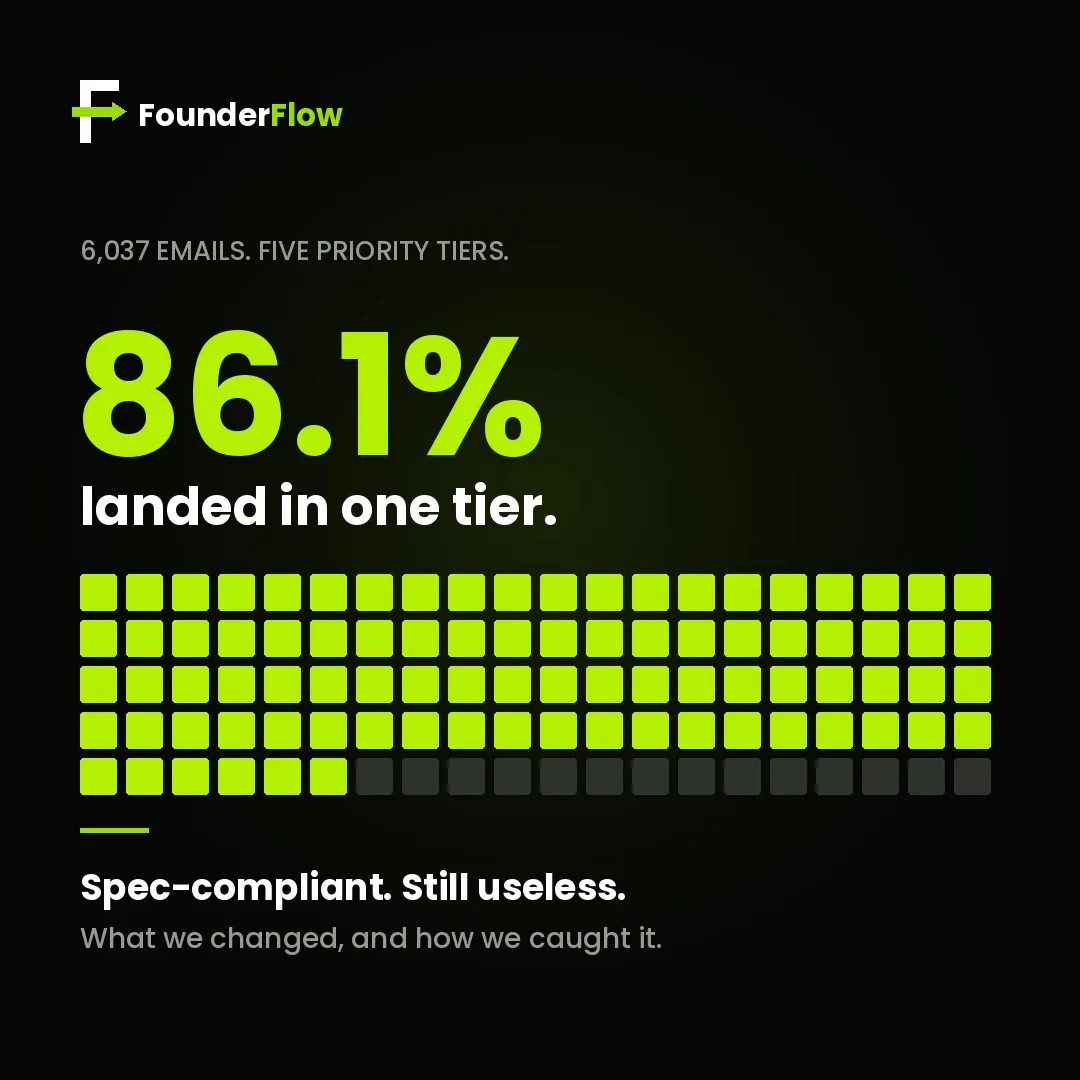
We built a feature that sorts business email into five levels of urgency act now, review today, monitor, routine, no action. Before turning it on for anyone, we ran it across 6,037 real emails to see how it behaved.
Every production AI system eventually encounters failures. The challenge isn't just fixing them it's understanding why they happened in the first place.
I'm interested in how teams investigate failures after deployment.
Do you collect execution traces, save intermediate reasoning steps, analyze tool calls, or build custom debugging dashboards?
What has made the biggest difference in helping your team identify the root cause of difficult AI agent failures?
Every founder has questions, whether it's about hiring, fundraising, getting the first 100 customers, pricing, AI, operations, or simply making difficult decisions.
Building an AI agent is one thing, but deciding when it's actually ready for real users is much harder.
Unlike traditional software, an AI agent can perform perfectly in testing and still behave unexpectedly when it encounters new situations in production.
I'm curious how other teams approach evaluation before deployment.
Do you rely on benchmark tasks, automated evaluations, human reviewers, simulated user interactions, or something else?
I have been managing several communities and doing marketing for over 3 or 4 years, and I have noticed a pattern where about 80% of people "test" you to see if you will do things for them for free.
I also notice that people from certain countries tend to do this more often. For example, Central and Eastern Europe + Southeast Asia.
On the contrary, people from the USA and China are willing to pay.
Both AirPods Pro 3 and Ear (3) launched this month. I m curious what folks would get? I really like the design of Ear (3) and I can see myself using the Super Mic on the case a lot but . From seeing all the reviews on the AirPods Pro 3 it seems that their quality of sound, ANC, and microphone is better. So might have to pick those as the winner for me. What does everyone else think?
For I've been dealing with this problem - How do you guys manage to handle all the posts, links, content and research on the trends? Don't you all feel a bit too cluttered managing it all on bookmarks, notion or even inside the saved features of the apps themselves?
Shipping an AI agent is only the beginning. Once it's being used by real users, monitoring becomes just as important as development.
Traditional software monitoring focuses on uptime, latency, and errors, but AI agents introduce additional questions. Are they making good decisions? Are tool calls succeeding? Are they completing tasks efficiently? Are they getting stuck or behaving inconsistently?