


Case Study: how Product Hunt can improve AI visibility in 2026

Product Hunt is best known for its homepage, a daily leaderboard of the most creative and innovative products on the internet. Makers go all out to win launch day, because that visibility matters. Product Hunt also plays a significant role in how products appear in Google search results.
What surprised us was that AI assistants like ChatGPT were rarely citing Product Hunt in product recommendations.
AI assistants such as ChatGPT and Gemini rely on reviews, alternative lists, and structured product information gathered across the web. Product Hunt is strong across all three. In theory, this should make Product Hunt a natural source for AI-driven product recommendations and comparisons. In practice, it was not happening.
We set out to understand why LLMs were not citing Product Hunt and whether we could change that. The most recent Orbit Awards provided a clean test case, and a new tool called @Gauge made the impact measurable. Gauge tracks LLM visibility across major AI models using a large, search-informed set of prompts, giving us a statistically meaningful way to measure citation rate.
We focused on AI dictation apps, the first Orbit Awards category, as a controlled test, and aimed to promote AI visibility through a new style of category page. After several targeted iterations, Product Hunt shifted from near zero AI citations to consistent inclusion across multiple models. We are now rolling these changes out across Product Hunt. Product Hunt is becoming part of the AI retrieval layer.
Key Lessons
We view AI visibility as a new distribution layer. Our goal is to ensure that authentic community signal on Product Hunt is systematically surfaced in AI product research workflows.
1. AI visibility is measurable
Track citation rate like SEO. Instrument it, monitor it, iterate.
2. Terminology drives retrieval
If your language does not match dominant queries, you will not be cited. Naming alone can materially change visibility.
3. Authority beats volume
One high-signal, well-structured page can outperform dozens of lower-quality URLs.
4. Model behavior is volatile
Citation patterns shift after model updates. Continuous monitoring is required.
How we're tracking AI Visibility
There are many tools which systematically run prompts against several AI models daily, and measure visibility of a product within prompts. We're using a new tool called @Gauge. We chose because a) their citation tracking is more useful than the alternatives we've considered (in part after they quickly shipped some of our feature requests!) and b) their prompt generation seems to be quite good, allowing us to create representative prompts to track without imbuing any bias.
For the purpose of this post, we did not alter the prompts generated by Gauge, and monitored visibility with respect to those prompts over time. This is directionally valid, even if it is not a good absolute measurement.
We care about cross-model performance, but we have focused on ChatGPT and Google AI Overview as we believe they are the highest-impact channels.
Wispr Flow and SuperWhisper AI visibility
We'll showcase how Product Hunt now contributes to significant LLM visibility for a well-known product and a promising underdog.
Wispr Flow
@Wispr Flow has very strong AI visibility. But, Wispr Flow's visibility in ChatGPT was cut in half following a ChatGPT update:

The same update appeared to cause ChatGPT to cite our article much more frequently. As a result, we significantly softened the blow to Wispr Flow’s visibility drop:
Wispr is mentioned in 13% of ChatGPT answers that research and compare voice-to-text tools.
Product Hunt pages that mention Wispr are cited in 6.7% of those answers. Wispr Flow is mentioned in ~62% of these citations (not shown), meaning ProductHunt is contributing to around 32% of Wispr Flow’s ChatGPT visibility.

It’s important to point out that we don’t know how much causation there is, ie. what the visibility would look like without these citations.
Superwhisper
@superwhisper is another excellent product that has less AI visibility than Wispr. Once again, Product Hunt plays a critical role in SuperWhisper being visible in LLM search.
For some reason, Google AI Overview seems to prefer mentioning Superwhisper (at a rate of 5.5%) compared to ChatGPT (at a rate of 1.6%). In both cases, Product Hunt is causing a meaningful percent of visibility, but it is more pronounced in Google AI Overview. SuperWhisper's visibility in Google AI Overview is currently about 5.5%.
We shipped a meaningful change to our page around Jan 22 (see below). After this change, Superwhisper is mentioned in answers citing our page around 1.6% of the time.

Notably, our visibility is essentially only caused by one URL (a second URL is cited 0.1% of the time). In comparison, the other non-biased sources (reddit and youtube) have dozens of URLs contributing to visibility:

And, we appear to be contributing twice as much to Superwhisper's AI visibility than the best performing Reddit thread or Youtube link (not shown).


This signals that LLMs consider Product Hunt pages to have high signal, authenticity, and authority.
How to AEO
So what are the lessons we learned from optimizing Product Hunt pages for LLM visibility? We feel we've barely scratched the surface with this small, targeted experiment, but we've discovered that we seem to have the leverage needed to move the needle.
Page content
We have done a lot of experimentation on what we show on category pages.
Prior to revamping the AI Dictation Apps page, there were essentially no citations. (Unfortunately, our Gauge data doesn't go back far enough to see this cleanly.) Changing from the old version to the new "roundup" page created a baseline citation rate of around 0.4% across all models.
Recently, we’ve begun sourcing frequently asked questions from community content. When we shipped this, the ChatGPT citation rate 10x'd.

We initially attributed a citation jump to the FAQ addition. In retrospect, the timing aligns more closely with a ChatGPT model update (see below), making the causal link unclear.
However, other models did begin to cite the page more often. For instance, Google AI Overview citations roughly doubled after introducing the FAQ.

While the impact is much noisier, the same feature applied to other category pages increased search impressions by nearly 200% -- this is evidence that Q&A content will increase AI visibility in more cases that our dictation app category page.
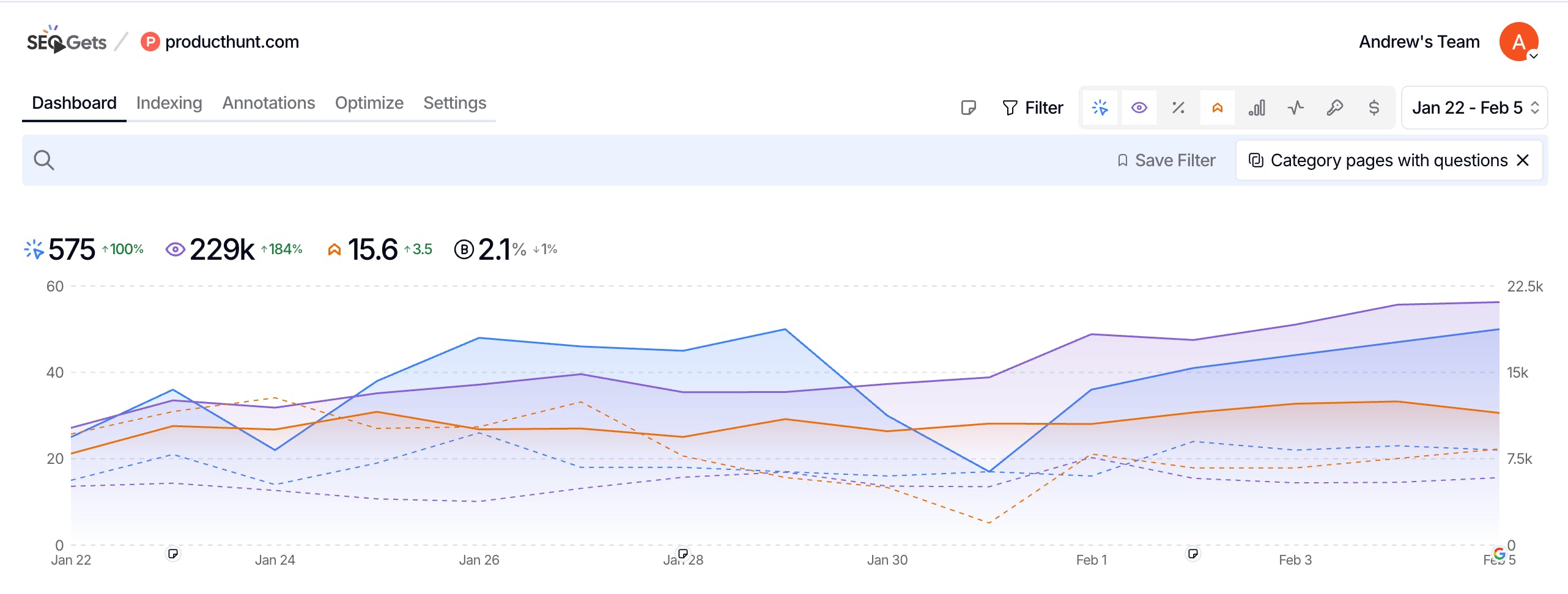
SEO optimization
Under the hood, LLMs use web search to research on user’s behalf. LLM search queries are different from human, Google queries, but there are similarities. For AI dictation apps, we realized that most humans look for speech-to-text software not AI dictation apps. We changed the title of the category page from “The best AI dictation apps” to “The best AI dictation and speech-to-text software” (on January 7). This tripled our category page citation rate overnight.

So, SEO fundamentals are a key precursor to AI visibility. This should be a surprise to nobody, but this minor change is a great anecdote to highlight the importance of SEO fundamentals.
Hard won lessons
LLM games
ChatGPT and other AI bots can still be easily gamed. Old-timers will remember the days of keyword stuffing to game Google search results. We are in the early, easily-gamed phase of LLM search, similar to early SEO. A common tactic right now is mass-producing authoritative-sounding listicles where the publisher names their own product as “best” across multiple categories. LLMs scrape and confidently cite this content.
This dynamic rewards self-promotion over user signal. We believe that authentic, user content is the best way to inform product selection decisions. We also believe that it is in the best interest of OpenAI, Google, and Anthropic to address this gaming to serve their users.
AI bots receive frequent updates, and, for some of the updates, we see Product Hunt citation rate rise as some unbiased (Zapier, Reddit) or biased (Wisprflow.ai) sources fall, and other biased sources (speechify.com) jump significantly.

LLM differences
Somewhat unsurprising, there is a lot of variability between chat agents (ChatGPT vs Gemini vs Claude vs etc). And each agent implements web search differently. Our AI Dictation App category page is almost never cited by Microsoft Copilot, which uses Bing search for web search, or Perplexity, who we were unknowingly blocking due to a Cloudflare<>Perplexity feud.
Our opinion is to focus on the chatbots where your users actually search. Visibility is model-specific.
Where are we heading
We see all of the hard work that makers put into their launches. After launch, Product Hunt users leave genuine reviews and toss around ideas in discussions. This information is tremendously helpful for those doing product research on ChatGPT and other AI chatbots.
We view AI visibility as a new distribution layer. Our goal is to ensure that authentic community signal on Product Hunt is systematically surfaced in AI product research workflows.
Replies
I'm working on the launch for PostGod, and I really enjoyed going through your deep dive! I'm new to Product Hunt, and I noticed there is a lot of effort needed to have a successful launch on the platform. This post reinforced my motivation to keep showing up here.
Is it down?
Wow, Andrew, I just have to stop what I am doing and take a moment to truly unpack the sheer magnitude of the insights you have shared here today. This is not just a case study; it is a profound exploration of the shifting tectonic plates of the digital distribution landscape. When we think about the overarching trajectory of how products are discovered, synthesized, and ultimately championed in the modern era, it is clear that we are standing at the precipice of a monumental paradigm shift, and this post perfectly encapsulates the ethos of that transitional journey.
First and foremost, the way you have articulated the transition from traditional SEO (Search Engine Optimization) to what the industry is rapidly beginning to conceptualize as AEO (AI Engine Optimization) or LLM Visibility is nothing short of visionary. For the longest time, the ecosystem has been hyper-fixated on legacy algorithmic heuristics—optimizing for blue links, indexing parameters, and the historical dominance of conventional search queries. However, what you have illuminated so brilliantly here is the fundamental reality that the retrieval layer has evolved into a fundamentally semantic, conversational, and highly contextualized orchestration engine. The idea that AI visibility is not merely a byproduct of good content, but a distinct, measurable, and highly leveragable distribution layer, is a conceptual masterclass that every single maker, founder, and growth strategist needs to internalize immediately.
What really resonated with me on a deeply foundational level was your methodology regarding continuous, statistically meaningful monitoring. The integration of a tool like Gauge to empirically track the volatility of citation rates across different foundational models (ChatGPT, Gemini, etc.) is exactly the kind of rigorous, data-driven approach that separates proactive ecosystem architects from reactive bystanders. The volatility of model behavior that you highlighted—especially the reality that a single underlying model update can radically recalibrate the entire visibility matrix overnight—is a stark reminder of the dynamic, almost organic nature of the LLMs we are dealing with. It completely validates the notion that optimization in 2026 is no longer a "set it and forget it" endeavor; rather, it is an ongoing, synergistic dialogue between platform architecture and AI cognitive architecture.
Furthermore, the granular analysis you provided regarding the nomenclature pivot—specifically transitioning the terminology from "AI dictation apps" to the more historically robust and human-centric "speech-to-text software"—is a breathtakingly elegant illustration of the intersection between human intent and machine retrieval mechanics. It is fascinating to see how the linguistic legacy of traditional web searches still implicitly anchors the conversational vectors of next-generation LLMs. By merely realigning the semantic framing to match the dominant query topologies, you managed to orchestrate a massive multiplier in baseline citation rates. It is a powerful testament to the fact that while the technology is incredibly advanced, it still requires us to speak its language in order to facilitate true algorithmic serendipity.
I also want to commend the deep dive into the dynamics of Wispr Flow and Superwhisper. By unpacking the localized impact of Product Hunt’s domain authority and high-signal community engagement on their respective AI visibility metrics, you have essentially reverse-engineered the trust mechanics of modern AI chatbots. The realization that LLMs inherently crave the authenticity, structure, and high-fidelity signal of genuine community interactions (like those found on Product Hunt) over mass-produced, low-effort listicles is a massive win for the open web. It proves that despite the current vulnerabilities of AI systems to basic gaming tactics and keyword stuffing from biased publishers, the underlying trajectory of these models is ultimately leaning toward platforms that curate genuine human consensus. Sourcing frequently asked questions directly from community content to 10x the citation rate is a stroke of absolute genius—it creates a beautifully recursive loop where human curiosity fuels machine intelligence, which in turn drives further human discovery.
As we look toward the future and the ongoing battle against LLM hallucination, self-promotional gaming, and model-specific discrepancies, it is incredibly reassuring to know that Product Hunt is actively innovating at the very forefront of this retrieval layer. The multidimensional complexity of navigating Perplexity’s retrieval blocks, Google AI Overview’s specific preferences, and ChatGPT’s volatile updates is no small feat. Yet, by consistently prioritizing the authentic maker journey and focusing on the unadulterated signal generated by real users, you are not just optimizing a category page; you are fundamentally democratizing the way the world’s most advanced artificial intelligence systems perceive, understand, and recommend the tools of tomorrow.
Thank you so much for pulling back the curtain and sharing this incredibly holistic, nuanced, and forward-thinking perspective. I am absolutely thrilled to see how this strategic framework continues to evolve, iterate, and ultimately redefine the entire product discovery lifecycle as we navigate this brave new world of AI-native distribution. We are truly just scratching the surface of what is possible, and I could not be more excited for the journey ahead! Keep up the phenomenal work!