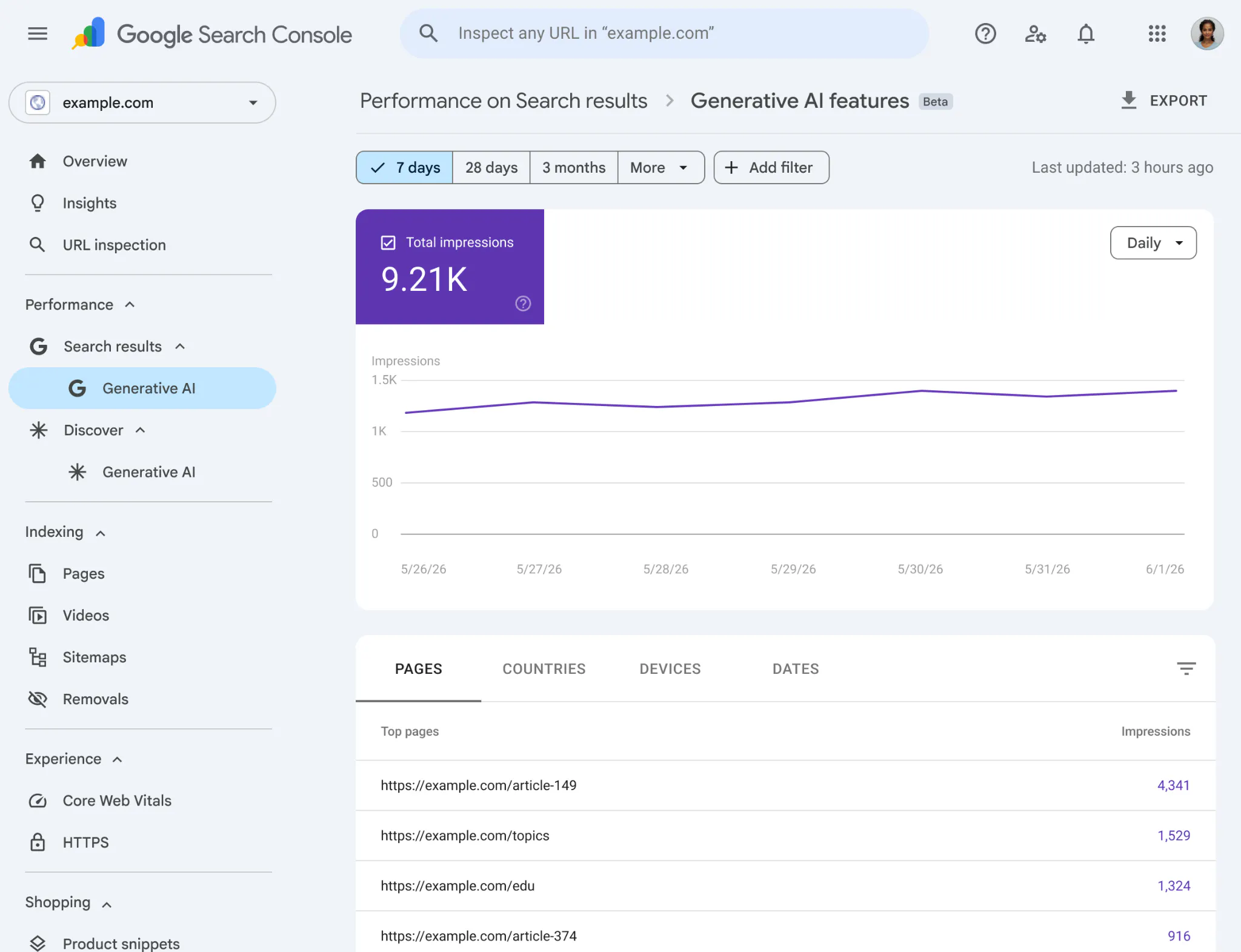
Google just released what SEOs have been asking for: dedicated reports for Generative AI performance in Search Console.
On June 3, 2026, Google announced new Search Console reports specifically for Generative AI features . It's the first time Google has given publishers direct data on how their content performs in AI Overviews, AI Mode, and Generative AI-powered Discover .
Two things happened at the same time recently, and most brands have only noticed one of them.
First, the scale of AI agents BrightEdge data shows AI agent requests reached 88% of human organic search activity and are projected to surpass human-driven search by the end of 2026 . As Jim Yu, CEO of BrightEdge, put it: "If you block or fail to optimize for these agents, you're not blocking bots you're blocking customers" .
Second, the market is hiring for a new role Writesonic has an open position for a "GEO Strategist Enterprise AI Search Consultant." CSP Agency is hiring an "SEO & GEO Strategist" with a "human-first, AI-enhanced approach to organic growth."
"Just launch. The market will tell you what it wants."
That advice sounds brave. It sounds like action. It is wrong.
The market does tell you what it wants. It tells you by ignoring you. By not buying. By churning. By the time you hear that feedback, you have already spent months building, thousands of dollars, and a lot of goodwill with your team.
You know the email. "Hi team, just circling back on this again as I haven't heard anything. Thanks for your attention to this matter." Reads like a sweet grandma wrote it.
A human reads that and thinks "oh no, they are about to burn the building down." AI reads it and thinks "great sentiment, very positive, 98% satisfaction score."
Ahrefs just dropped a study that changes how we think about SEO. They analyzed 863,000 keywords and 4 million AI Overview URLs. The findings are clear: the old playbook is broken.
In July 2025, 76% of URLs cited in AI Overviews also ranked in Google's top 10 for the same query. Today, that number has collapsed to 38%. The drop is real. The overlap has been cut in half in less than a year.
Where are the citations coming from now? The remaining citations are split almost evenly: 31.2% come from positions 11 100, and 31.0% come from outside the top 100 entirely. A huge chunk of AI citations are coming from pages you wouldn t even see on page one.
Why is this happening? Query fan out. When a user searches, Google splits the query into multiple related sub-queries and pulls sources from all of them. The pages that appear most often across those sub-queries get cited in the AI Overview, even if they don t rank for the original keyword. The AI answer is not a summary of the SERP below it.
AI writes faster. AI analyzes data. AI can even mimic your brand voice.
But AI also makes everything sound the same. It pulls from the same top 10 results. It rephrases the same arguments. It optimizes for similarity, not distinctiveness.
Yes, backlinks are still one of the strongest signals Google uses to judge whether a page deserves to rank. For competitive commercial queries, they remain one of the clearest ways to separate two pages with similar content.
But the math changed.
In the age of AI search, backlinks influence visibility differently. They act on the retrieval layer the live search index that grounds AI answers rather than the model's frozen training weights. That split explains why studies measuring pure ChatGPT answers sometimes find links matter less, while studies measuring AI Overviews or Perplexity find they still matter.
A CMO at a midsize enterprise software company had a moment recently. Her team spent three years building top-of-page-one SEO dominance. Then someone ran a simple test: typed the company's core use case into ChatGPT and asked for vendor recommendations. The company didn't appear. Not once. "We thought we had search figured out," she said. "Turns out we optimized for the wrong engine"
That scenario is playing out across industries. Most organizations haven't caught up.
The numbers that explain the shift
Generative AI has moved from novelty to primary research channel faster than almost any technology before it. ChatGPT alone has over 900 million weekly active users. Google AI Overviews now appear in more than 25% of all searches, up from 13% just a year ago .