Backlinks are still one of the strongest signals Google uses to judge whether a page deserves to rank . But the math changed. Google's December 2024 and October 2025 spam updates devalued link networks, paid placements, and AI-generated guest-post farms . The old volume play is dead. The new play is about quality, relevance, and context.
In the age of AI search, backlinks influence visibility differently. They act on the retrieval layer the live search index that grounds AI answers rather than the model's frozen training weights . A domain's Authority Score correlated with AI mentions at Pearson 0.65, according to a Semrush study of 1,000 domains tracked across five AI surfaces . Raw backlink volume correlated far more weakly.
Saw a post this week from someone in the industry. They said they've been an SEO for eight years, and lately, they feel like any junior with an AI agent can match their output. The post got huge. A lot of people quietly feel the same .
It hit a nerve. Because the shift has been real. And fast.
What's changed
For twenty years, SEO was about keywords, rankings, and links. You optimized pages for a search engine, you built backlinks, you climbed the SERPs. That was the job .
There is a point in every product's life where it crosses a threshold. The person who built it can still explain it. But the person who just joined cannot.
The complexity is not in the code. It is in the context. The decisions that were made. The compromises that were accepted. The edge cases that were built around. The technical debt that was deferred.
No one writes those down. They just become the way things are.
The threshold is crossed when the product can no longer be fully understood by one person. Not because the person is less capable. Because the product has absorbed too many decisions that no one remembers making.
The data is clear: backlinks are still a valuable part of any SEO strategy. Nearly 70% of marketers say backlinks have a "big impact" on search rankings, and 30% say they have a "moderate impact". The top result in Google SERPs has nearly 4x more backlinks than positions two through ten. Marketers are spending $5,000 $10,000 monthly on link building, and a single low-authority link now runs around $300 almost 8% higher than last year.
Generative AI made mass content production cheap. Many brands thought they had found a content cheat code. Spin up thousands of pages overnight, vacuum up search traffic, and watch organic revenue climb.
Instead, a quiet crisis is playing out across enterprise SEO. Aggressive programmatic AI initiatives are stalling, collapsing, or triggering manual penalties.
This is not happening because Google hates AI content. It happens because these initiatives break the foundational mechanics of Google's crawl ecosystem, indexing thresholds, and quality controls.
Last week, six AI products launched on Product Hunt that share one move. None of them ask users to open a new app. They embed into surfaces people already touch.
Hardware: Dune Keypad (46 upvotes) sits next to your keyboard with Claude integration. Video calls: Mina Meeting Assistant (47 upvotes). Text threads: folk (51 upvotes). Chat windows: Databox MCP (39 upvotes) plugs business data into Claude via Model Context Protocol. Mac autocomplete: Typeahead (22 upvotes).
The pattern is clear: shipping AI as a new app is the slow path. The fast path is grafting onto a surface the user already touches. The cost of building a standalone AI app dropped 90%+. The cost of getting it noticed did not. Surface integration sidesteps the noticing problem because the surface already has users.
We analyzed 6.8 million AI citations across ChatGPT, Gemini, and Perplexity . The finding changed how we think about AI visibility.
The breakdown
First-party websites: 44% of citations
Business listings: 42%
Reviews and social content: 8%
Forums like Reddit: Just 2%
The most impactful sources are the ones you already control . This directly challenges the perception that Reddit and user-generated content dominate AI answers .
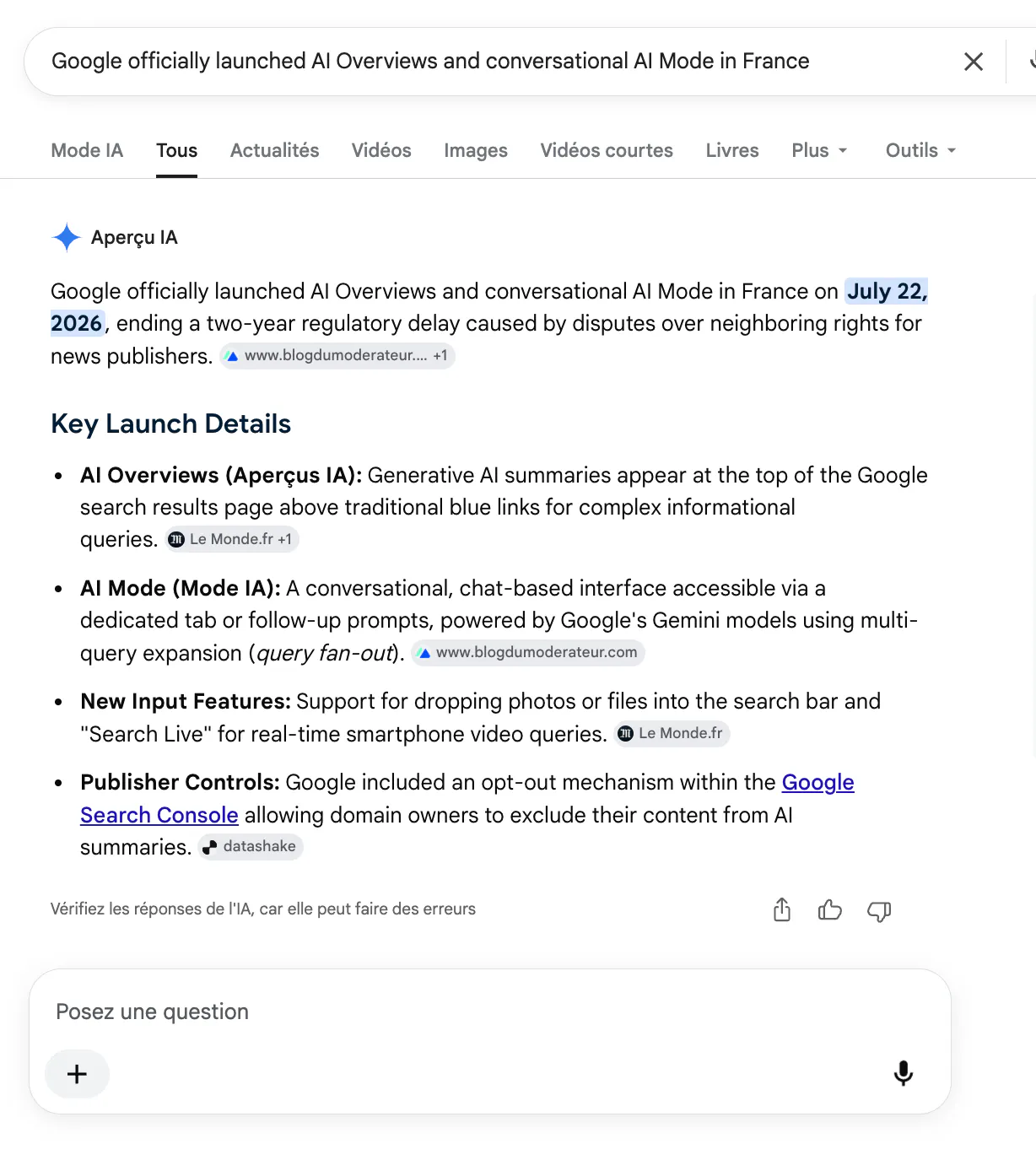
Today, July 22, 2026, Google officially launched AI Overviews and conversational AI Mode in France . France was one of the last major markets to get it. Now it's here.
For two years, French businesses watched from the sidelines while the rest of the world figured out what AI search actually does to traffic. Now it's their turn.
Here's what the data from other markets says about what happens next.