

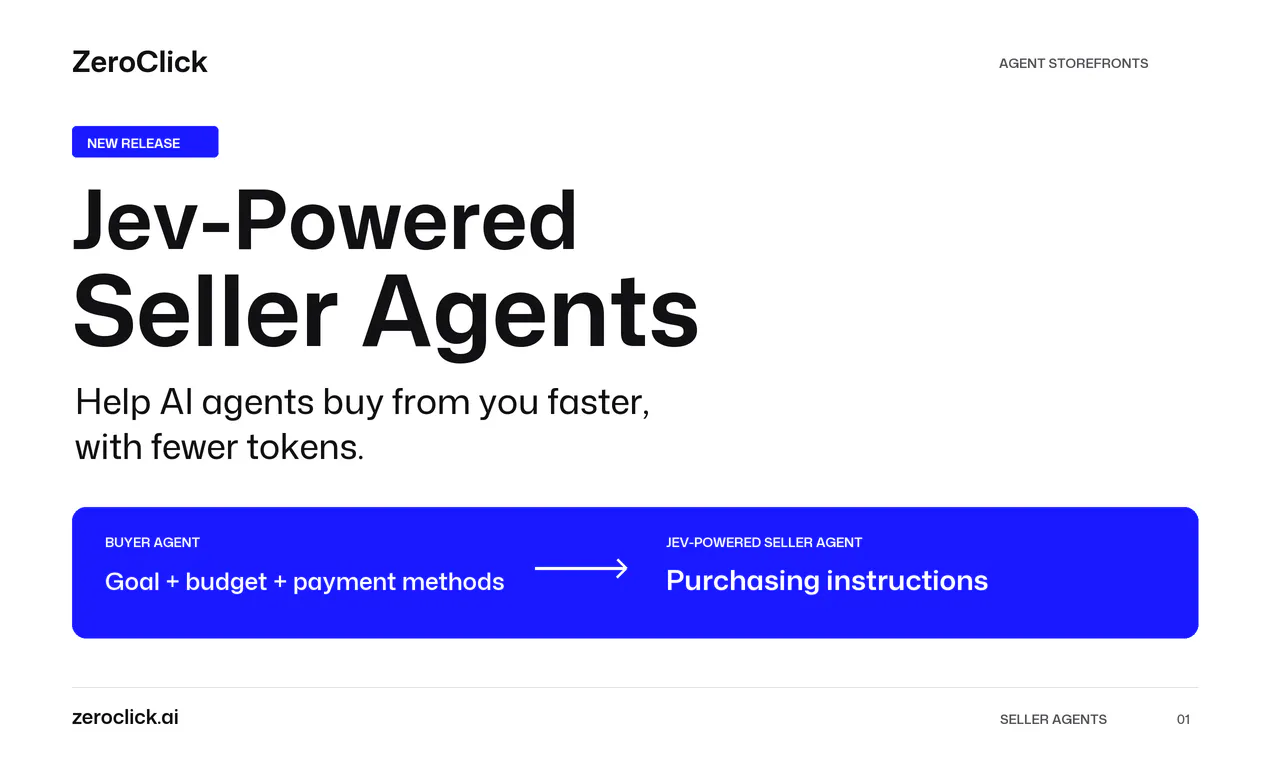
New: Jev-powered Seller Agents help AI agents buy from you faster

Hey Product Hunt! Michael here from ZeroClick.
We've added Jev-powered Seller Agents to our Agent Storefronts to help AI agents buy from your business faster, with fewer tokens spent figuring out how.
A buyer agent shares its goal, budget and available payment methods. Your seller agent turns that context into concrete purchasing instructions, so the buyer spends less time searching documentation and making trial-and-error requests.
In our testing, buyer agents used up to 27% fewer tokens on Claude Code and 9% fewer on Codex. Less trial and error means faster purchases and less inference spend.
We've also made storefronts easier for agents to navigate with per-service OpenAPI specs, pagination and fuzzy search.
You can read more in our October product update.
Where do buyer agents get stuck with your product today: choosing the right service, understanding payment options or completing the purchase? We'd love to hear a specific example!
Replies
The team had a lot of fun building this one! Cool to get to the edge of what's possible with Jev and new tech
Is this only about agent-to-agent interactions? What if I want to buy a product from an online store as a regular user? Do you have agents for that? And how do you get around bot blocks on large websites?
@mykyta_semenov_ this is about converting visiting agents into purchasing customers. human flows have a lot of great tooling around them to do the same! how we 'get around' bot blocks is that we stand up a separate, current agents.xxx.com storefront with the customer catalogue and information they wish to expose to visiting agents. it's agent native and designed to serve agents, not block them.
Yeah I think this only stays useful if the agent can show which product facts it used. I've had old landing-page copy survive way too long 😅 How are you keeping those sources current?
@matheus_paranhos1 we stand up a separate, current agents.xxx.com storefront with the customer catalogue and information they wish to expose to visiting agents. the Jev-powered seller agent then makes sure the proper answer is served to the visiting agent to save on token usage and lower latency throughput of capturing potential purchase intent.