
FoodHealth Score
Find healthier groceries while you shop online
157 followers
Find healthier groceries while you shop online
157 followers
FoodHealth Score is a free Chrome extension that scores every grocery product 1–100 as you shop at Target, Walmart, Amazon, Whole Foods and more. See if something's actually healthy. Get a smarter swap that fits your budget and dietary needs. Then watch your whole cart improve before you check out. Powered by a 200 billion purchase dataset and a proprietary nutrition algorithm that's being used by Kroger, Hy-Vee, NielsenIQ and others across the food industry to build a healthier food supply.


Free
Launch Team / Built With


Viktor.comAn AI coworker that actually does the work
Promoted



Hey Product Hunt! 👋 I'm Sam, Founder/CEO at FoodHealth Co.
My earliest memories are all about food. I grew up in an Italian-American family in New Jersey, and I remember sitting on my grandmother's kitchen counter at age 3, ripping parsley for her meatballs. She always prioritized fruits and vegetables at every meal and made sure we understood the importance of a well-balanced plate.
So it was jarring, two decades later, when she called to tell me that her A1C was too high. That if she didn't figure out how to turn it around, she was going to have to go on medication for diabetes. We didn't understand how this had happened when she's always prioritized eating well.
We spent a Sunday afternoon going through her pantry, looking for answers, and I was disappointed by what we found. Cereal that said "made with whole grains" on the front, but had 4 different kinds of added sugar on the back. "Organic Dark Chocolate" that was only 35% cacao and had a laundry list of ingredients on the back.
She, like many of us, thought she was buying the healthier option at the store because of what was on the front of the package. Unfortunately, the front of the package doesn't tell us the whole story.
We created the FoodHealth Score to remove the guesswork and answer the single most common question people ask about food: "Is this healthy for me?"
We started B2B - working with insurers and employers to use the FoodHealth Score in food-as-medicine programs. And watching it work on a smaller scale made me even more certain: this needed to reach everyone, at the exact moment they're deciding what to eat: at the store.
That led to our partnerships with Kroger & Hy-Vee, bringing the FoodHealth Score to millions of shoppers. And now, with this Chrome extension, it works on Target, Walmart, Amazon and Whole Foods, too. Bringing something direct to consumer gives us the ability to move faster & support more of the places you buy food.
Here's what it does:
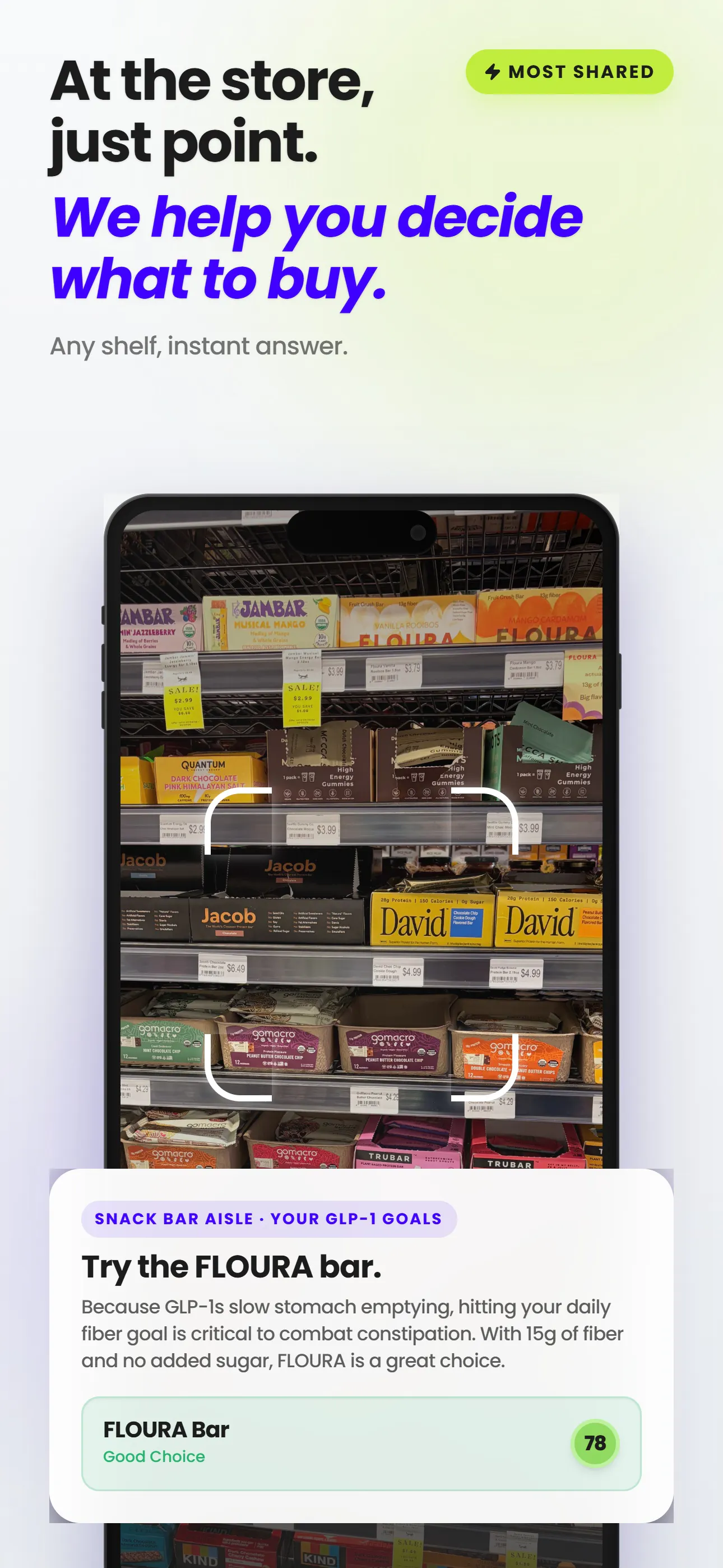
🔢 Scores every product 1–100 as you browse
🔄 Suggests a healthier swap (you can see insights on why we're suggesting it for you)
It's completely free. And right now we're giving away $2,000 in groceries - install and share with a friend to enter. Every friend who downloads it gives you an extra chance to win (closes April 30).
Would love to hear from you: what grocery store do you shop at most, and how can we best support you in making healthy choices at the store?
With two young kids, finding the time to eat healthy is nearly impossible. This truly makes my life easier :)
@christine_oleksiuk so glad we're making your life easier!
Kent here - I lead product at FoodHealth Co, working closely with Sam and our amazing crew. I'm so excited to see your prompts rolling in.
We built FoodHealth Score because nutrition doesn't show up in what you log in an app or what you tell a dietitian or what you tell chatGPT - it's down to what you buy. So we made this to be your healthy shopping companion right in your favorite grocers: Amazon, Whole Foods, Wal Mart and Target.
It’s rad, fun, and simple: just good sound dietary insight powered by our score to help you make these decisions just a bit easier. It’s important to me because I struggle with healthy eating, especially as I've gone on a GLP-1, and I’ve lost a number of family members to dietary conditions. My goal is to help as many people as possible to improve their health through food.
Check it out and give feedback. We'd love to make it better for you (with lots of exciting new things in the works already!).
this is an extremely powerful tool that we have been using for our weekly shops. It’s so easy and helpful. Thank you!
@max_alexander3 thank you! can you imagine anything that might be more helpful for you? What's missing that we could improve?
Every week clients ask me for websites/apps/resources to use outside our sessions. Finally, a dietitian that goes with you everywhere!
@mallory_bobzien thank you. How do you think we could make this even more useful for people like your clients? What’s the biggest pain point we could solve for them with shopping and health?
@heyitskent a few things:
healthier swaps -- ie. The most questioned item is bread -- everyone is looking for the healthiest bread (that also tastes good). And then broader, they're looking for the healthiest snack (ie. celery & peanut butter instead of potato chips)
what to eat -- also known as meal planning, but i think meal planning has a weird connotation. Not every client is planning for the entire week in one sitting, and they're not even struggling with every meal. Some people just need help with lunch, or making a balanced breakfast. And they're looking for ideas on what to make that is both healthy & enjoyable.
@mallory_bobzien flavor and health is a really interesting challenge. it's actually one we're trying to tackle now with our suggestions. I'll let you know when our improved algo is out -hopefully you try.
As to meal planning: there's a plethora of meal planning apps out there. What's missing from that space for you and the folks you work with, any sense? (it's a big Q I know)
This should have every online grocery store mandatory!
@busmark_w_nika thank you so much! I’m Kent, CPO here at the FoodHealth Co, and of course I feel the same :) but I’m curious what resonates about it for you? What could we do to make healthy food shopping even easier / better for you?
@heyitskent I am curious e.g. what is Vegan, Vegetarian or also macro/micronutrients (I came from fitness industry, so intrested in these parameters) :)
@busmark_w_nika that makes sense! we recently aggeded more details on macros and micros when you swap - would love to see if that works for you.
dietary preferences is certainly powerful and tricky so we want to approach that with care. I'm a vegetarian myself and I stop trusting anything that marks a product incorrect for me.
@busmark_w_nika could not agree more!
This tool delivers food transparency right when you need it most: during your shopping experience. It’s time we empowered ourselves to make truly informed food choices.