@vidit Yes! The AI uses two major structured data streams to collect a thorough symptomatology. First, we pulled data from hundreds of thousands of medical records to scope out the symptom space in primary and urgent care. Using this information, we were able to identify symptoms that highly correlate with the presence of other symptoms and that highly correlate with specific diagnoses. Second, to collect all of the information that a physician uses to assess a patient’s condition – more specifically, information that rarely makes it into the EMR in the form of structured data – we leveraged a team of 30+ physicians to scope out the “question space” that they utilize to develop a deeper understanding each individual symptom’s presentation. Together, these components form a medical graph with hundreds of potential diagnoses, hundreds of first-order symptoms, thousands of modifiers, and tens of thousands of relationships. Each patient interaction can be represented as a subgraph that we can vectorize and use as the input to algorithms that 1) generate physician-readable summaries and 2) make recommendations that we can validate against the gold standard diagnosis made by the physician (not only upon first evaluation but also upon 48-hour follow up). You can imagine how we can use this underlying data structure and vectorization scheme to tackle other interesting predictive/diagnostic/recommendation problems in the future.
@lucy_guo Thank you Lucy! That means a lot coming from such an inspirational designer :) Please let us know if you have any critique or feedback -- we'll make sure to continue to iterate the product to be as user-centric as possible.
Report
Thanks goodness for a product like this!! Please change the system! Congrats to you!


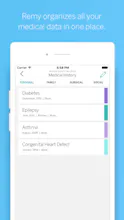



Remedy
Pitch a Date
Loco
Remedy
Pitch a Date
Pitch a Date
Pitch a Date
reQwip
Pitch a Date