

Your AI tools answer questions. Viktor does the work. It lives in Slack, connects to 3,000+ tools across your entire stack, and acts on its own. It watches how your team works, spots problems before anyone notices, and proposes automations built around how your company actually works, before anyone asks. It manages campaigns, builds apps, delivers reports, and writes code. And it runs for weeks without losing context, learning your company deeper every day. Not a chatbot. A coworker.
This is the 2nd launch from getviktor.com. View more

Viktor for Media Buyers
Launching today
Viktor is an AI coworker that lives in Slack and connects to 3,000+ tools. This launch focuses on what media buyers have been using it for: operating Meta and Google Ads accounts from a single message. Pause bleeding ad sets, scale winners, shift budget cross-platform, export reports to Sheets. 103 Meta Ads actions. 37 Google Ads actions. Real write access, not a read-only dashboard.



Free Options
Launch Team / Built With


 OpenClaw
Slack as the control plane for ads is a good call - media buyers already live there. The real test will be how it handles edge cases: campaigns hitting budget caps mid-day, sudden performance drops, audience fatigue signals. Does Viktor flag those proactively or wait to be asked?
getviktor.com
@mykola_kondratiuk That is one thing that is different from Viktor vs other Media Buyer products, especially the ones based on some "engine". Viktor will check the state of campaigns, and react to them very much like a top growth person would do.
That proactive stance is exactly the right model - reactive-only agents are basically just slower dashboards. Good luck with the launch!
getviktor.com
Hey everyone, Fryd here. Co-founder of Viktor.
We launched Viktor on Product Hunt a few weeks ago and hit #4 for the day. Since then, something interesting happened: media buyers started showing up. A lot of them.
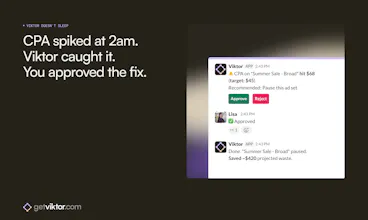
Turns out, when you build an AI agent that connects to Meta Ads and Google Ads with real write access, performance marketers find you. They don't care that Viktor can also manage your GitHub repos or build Slack apps. They care that it can pause a $68 CPA ad set at 2am while they're asleep.
So we built a vertical experience around it.
What Viktor actually does for media buying:
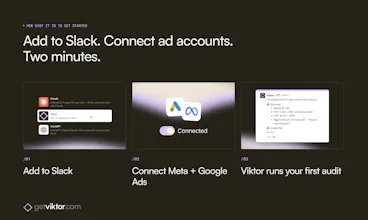
-> Connects to your Meta Ads and Google Ads accounts via OAuth (two minutes, no API keys)
-> Pauses underperformers, scales winners, adjusts budgets from a single Slack message
-> Shifts budget cross-platform: "Cut Meta by 30%, move it to Google exact match." Done.
-> Cross-references Meta's reported revenue against your actual Stripe charges (Meta over-reports by 20-40% for most of our users, mostly view-through attribution)
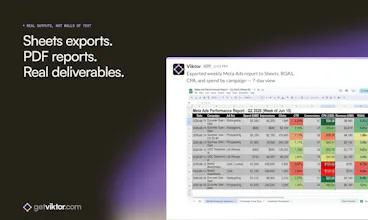
-> Exports weekly performance reports to Google Sheets
-> Runs overnight: if CPA spikes at 3am, Viktor pauses the ad set and tells you about it in the morning
The depth matters. Viktor has 103 available actions on Meta Ads and 37 on Google Ads. That's not "we can pull your campaign stats." That's pause, enable, adjust budgets, duplicate ad sets to new audiences, manage keywords, change bids, create automated rules, and export everything to Sheets.
What we're honest about: Ad copy changes on Google Ads (responsive search ads) still happen in the Google Ads UI. Viktor handles campaign structure, budgets, bids, targeting, keywords, and reporting. Not creative. We'd rather tell you upfront than have you find out on day two.
How to try Viktor:
1. Add Viktor to Slack (one click from the Slack App Directory)
2. Connect your Meta and/or Google Ads accounts
3. Ask Viktor to audit your last 7 days
You get $100 in free credits. No credit card. That's enough to run Viktor for weeks on typical media buying workflows. Most people see the value in the first audit.
We built this because we run ads ourselves and got tired of the morning ritual: open Meta Ads Manager, open Google Ads, open GA4, open Sheets, pull numbers, compare, decide, act. Viktor does that loop in 30 seconds from one Slack message.
If you run ads across Meta and Google, I'd genuinely like to hear what your workflow looks like. We're building the vertical pages and integrations based on what actual media buyers tell us they need.
getviktor.com/for/media-buying
@fwiatrowski Beyond pausing/scaling, what's one proactive rule you've seen media buyers set up in Viktor that's saved them the most cash?
getviktor.com
@swati_paliwal The one that surprises people the most: Stripe reconciliation.
You tell Viktor "compare my Meta reported revenue against actual Stripe charges for the last 7 days." Almost every time, Meta is over-reporting by 20-40%. Mostly view-through attribution inflating the numbers.
What happens next is the part that saves money. Once you see the real ROAS per campaign, you realize you've been scaling stuff that looked profitable in Ads Manager but was actually bleeding cash. One user found two ad sets they'd been scaling for weeks were basically break-even once you stripped out the phantom conversions.
Viktor can run that check on a schedule. "Every Monday morning, pull my Meta revenue vs Stripe actuals, flag anything where the gap is over 30%." That single routine has saved more budget than any pause rule we've seen, because it changes which campaigns you scale in the first place.
The overnight CPA pausing is great for defense. But the Stripe cross-reference is what actually changes your spend allocation. Most people don't realize how much they're over-investing until they see the real numbers side by side.
Wispr Flow
I hunt products I'd actually pay for. This is one of them.
I'm Head of Growth at Wispr Flow. In the early days, I was running everything myself — Meta, Google, reporting, the whole stack. The morning routine Fryd described is real. Four tabs, three dashboards, twenty minutes before you've made a single decision. Every day, before any actual work starts.
I kept wishing there was something that could just act. Not surface the data. Act on it.
That's what Viktor does. When you can say "cross-reference our Meta reported revenue against Stripe actuals and flag anything over 25% variance" and get an answer in a couple of minutes — that's not a productivity gain. That's a fundamentally different way of working.
The 103 Meta actions and 37 Google Ads actions aren't a feature list. They map to real decisions: budget pacing, audience segmentation, cross-platform rebalancing, overnight anomaly detection. The things I was doing manually at 7am so I could actually think by 9.
I hunted this because I know exactly what it would have meant to have it earlier. Media buyers aren't looking for another dashboard. They want an agent that can act. This is the first one I've seen that actually does.
Start with the audit. Ask Viktor to review your last 7 days. That's where it clicks.
Love the idea of managing ads from Slack! How does Viktor handle campaign optimization — is it rule-based or AI-driven?
getviktor.com
@sachin_madhukar Good question. It's AI-driven, not a rules engine.
You talk to Viktor in plain language. "Pause anything above $60 CPA." "Move 30% of Meta budget to Google exact match." "Audit last 7 days and flag what's underperforming." Viktor understands the intent, pulls the data, and takes action across both platforms.
Where it gets interesting is scheduled tasks. You can tell Viktor "check my campaigns every morning at 7am and pause anything that crossed my CPA threshold overnight." That runs automatically, but it's still the AI making contextual decisions - not a static if/then rule. It looks at your recent performance history, not just a single metric in isolation.
The difference from rule-based tools: Viktor can handle compound requests. "If CPA is above target AND spend is over $200 AND it's been trending up for 3 days, pause it" - that's one Slack message, not three rules you need to configure in a dashboard.
The $100 free credits are enough to test the full loop. Most people start with an audit and see the difference pretty quickly.
This product seems cool, do you have plans to integrate tiktok
getviktor.com
@roy_kek We definitely want to support additional ad platforms, including TikTok. We're building the right foundations first so we can integrate them properly, but doing that well takes meaningful effort. Stay tuned!
getviktor.com
Vadym here, engineer at Viktor.
I worked on the skills system that powers Viktor's media buying workflows. Think of skills as muscle memory for an AI - pre-built knowledge about how ad platforms work, what good performance looks like, and what to do when something goes wrong.
When a media buyer asks Viktor to 'audit my last 7 days,' a lot happens under the hood. Viktor pulls data from both platforms, normalizes the metrics (Meta and Google report differently on basically everything), cross-references against your historical performance, and formats it into something you can read in 30 seconds.
Building that felt like writing a playbook for a media buyer who never sleeps and never forgets what your CPA looked like three weeks ago.
The skills keep getting better too. Every edge case, every new request pattern, every workflow a user invents goes back into the system. Viktor for media buying today is noticeably sharper than it was a month ago.
getviktor.com
Filip here, GTM team at Viktor.
I remember when Viktor was still a baby... before we launched in February.
His first "baby steps" were exactly that ➡️ helping us out with management of our own ad ideation -> creation -> performance + spend management.
Here's a use case we didn't plan for: founders who know they should be running ads but don't have a dedicated media buyer. They're managing campaigns between product calls and investor meetings.
Viktor isn't replacing experienced performance marketers. But for smaller teams without a hire yet, it fills the gap between 'we should be doing this' and 'we can't afford someone full-time for it.'
Think of it as the operational layer for ad management. It monitors your campaigns while you do literally everything else. Catches the CPA spike at 2am. Flags when Meta claims more conversions than your Stripe dashboard shows. Runs the daily performance check you keep promising yourself you'll do.
If you know your ad spend needs more attention than you're giving it, the free audit is a solid place to start. It shows you what Viktor would catch that you're currently missing.
And the best thing about it all? You'll just have fun talking to Viktor in Slack, like to any other coworker 🙌