

WEIR AI
Track your identity online to protect it or earn from it
303 followers
Track your identity online to protect it or earn from it
303 followers
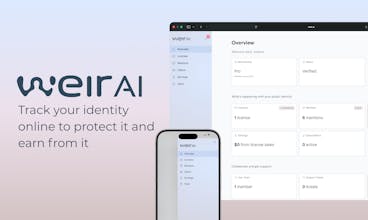
WEIR AI is a privacy-first platform to help you find and protect yourself online. Set your terms, monitor for mentions (including hidden ones), get public identity checkups, and file claims or license on your terms.







WEIR AI
Having my first cup of coffee this morning. Got a good reminder from my dinner in Oakland last night. I describe WEIR and immediately get worried questions about the potential for surveillance and abuse. Fair. I spend so much time inside this that I forget people don't already know what I know, even though we try to communicate this clearly.
So what safeguards have we put in place? Identity verification before we detect your deep mentions, plain English consent, what we find is private by default, you control who sees your data, delete anytime, download anytime, pursuing open standards so you're not locked in, passkeys and OTP only. Subscription model where you're the customer, not the product.
Being a for-profit, mission-based company is part of what enables this. The business model and the mission point in the same direction and that's not an accident.
Still thinking about that conversation (clearly).
Your360 AI
This looks powerful, and unfortunately in today's world couldn't be more necessary. Do you support LinkedIn montioring? Or mostly focused on Meta / X properties?
WEIR AI
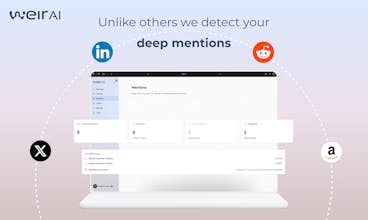
@jared_goralnick Good question Jared. Yes, we do support LinkedIn today. LinkedIn remains the premier place for professionals to find and share with each other so your rep -- positive or negative -- on LinkedIn matters and your'e not always tagged directly when you appear there so our system keep its eyes open for you with your permission.
Your360 AI
@gary_mccoy that sounds awesome! Great to know.
WEIR AI
@jared_goralnick Yes, we support LinkedIn posts right now. We're not yet looking at LinkedIn profiles until we work out how to do so without effectively invading other people's privacy.
WEIR AI
I have always been fascinated by how technology shapes, constrains, and impacts human identity and our sense of self. Long before deepfakes and AI generative models became dinner table conversation, I was writing my PhD on the relationship between technology and personal identity, and how we need to revisit law and policy to make technology an instrument of identity protection and expression. My core conviction, then and now, is that people deserve the right to define and express their own identity on their own terms, and that the design of technology is never neutral in that equation.
That conviction accompanied me, years later, to Meta, where I had the privilege of working alongside some of the sharpest minds I've ever encountered, including Gary McCoy and Tal Hassner. Together, we navigated the complex, often treacherous terrain of deploying facial recognition and identity technologies at scale: the technical challenges were immense, but the legal and policy dimensions were equally daunting. We saw firsthand the challenges in building AI responsibly, and how much was at stake in that endeavor.
Fast forward to today: what was once a frontier concern is now an urgent crisis. The ability to mimic, replicate, and manipulate a person's identity - their face, their voice, their likeness - is no longer the preserve of sophisticated state actors or well-funded labs. It is cheap, fast, and frighteningly accessible. The question of who controls your identity, and on what terms, has never been more consequential.
This is precisely why Weir.AI exists - and precisely why I couldn't say no when the opportunity came to work with Gary and Tal again. Their vision is not just technically sophisticated; it is morally serious. Weir.AI is on a mission to invert the power dynamic entirely, giving individuals the tools to discover, control, and set the terms for how their identity is used across the digital world.
For me, joining Weir.AI represents the convergence of everything I've studied, built, and believed in - with people I deeply respect, at a moment when the work genuinely matters.
WEIR AI
@norberto_andrade Its amazing to have an opportunity to make the hard decisions to build in a manner which prioritize people's safety, privacy and security.
The "protect it or earn from it" framing is interesting, as I know that most privacy tools are purely defensive.
What does the "earn" side actually look like in practice? Are people licensing their likeness for AI training, or is it more about catching unauthorized use and claiming compensation?
Congrats on the product and launch!
WEIR AI
@andreitudor14 Good question Andrei. We have a particular vision we're trying to convince the major platforms of for what 'earn it' should look like, but today, it starts with collecting evidence, understanding what rules are in play, and issuing claims. This is useful for high profile people with representation but may not be ideal for individuals who are not high profile and/or who do not have teams around them.
Another 'earn it' path are marketplaces where people want to use your likeness for things like AI training, testing, creative projects and more. We're slowly building a network of partners who are interested in having pre-authorized, properly obtained identities for those purposes. Since we let you express your rules/limits (e.g. someone may not want to appear in ads for alcohol, cannabis, or tobacco while someone else wants to be in everything) so that we can automatically enforce them. Does this help?
WEIR AI
Hey PH I’m an ML Engineer at WEIR AI.
From the AI side, the problem we’ve been tackling is how to detect and attribute identity usage online in a way that’s reliable, privacy-aware, and resilient to messy real-world media (compression, cropping, re-uploads, edits, partial views, style transfer, etc.) without turning it into a surveillance product. We’ve been especially focused on evidence-first detection, meaning we optimize for producing actionable signals (what matched + why) instead of black-box “trust me” outputs, with careful thresholding, calibrated confidence, and enough provenance for users to make decisions. We’ve also prioritized robustness over demo-magic because the internet is adversarial by default, so we test heavily against common transformations and treat false positives as a top-tier failure mode. On the privacy side, we’ve aimed to minimize data retention, keep results private by default, and build flows that prioritize consent and user control, because the tech is only useful if it’s safe. And while automated matching has given speed, disputes and edge cases still need human-in-the-loop escalation paths with transparent, reviewable evidence.
If you’re building in this space too, we’d love to hear what you think are the hardest unsolved bits provenance, evaluation benchmarks, policy enforcement, or adversarial resilience.
WEIR AI
@tewodrosseble Glad you're on this journey with us.
WEIR AI
WEIR AI
Hey folks,
I’ve had the privilege of working directly with the team building Weir.ai, and it’s rare to see a product that not only tackles a real-world problem but does so with deep empathy and intelligence.
What excites me most about Weir.ai is how it demystifies a space that’s traditionally opaque, complex, and shaped in favor of those who already know the rules. For too long, the barrier to truly understanding where and how you show up and what control you have has been prohibitively high. Weir.ai changes that.
This team doesn’t just build tools; they build clarity and you generate income. I'll continue to invest my time and energy in Weir.ai because it just makes sense. It isn’t just useful, it feels essential.
WEIR AI
@rochelle_williams1 It is a privilege to be able to take all we've learned about how this kind of technology can be designed and constructed ways that give people visibility and control over something as important as their own identity.