That's one of the things I went down a rabbit hole on for Edition #53, which went out this Sunday, to celebrate last week's World Poetry Day
Diana Ferrus was studying in the Netherlands when she wrote a poem about Sarah Baartman, a South African woman whose remains had been held in Paris for nearly two centuries. The poem became so powerful it was eventually incorporated into French law and helped bring Baartman home.
The news dropped yesterday: OpenAI is shutting down Sora, their AI video app, six months after launch. The Disney $1B deal is off, and the API is going away, too.
The arc is fascinating if you zoom out. The app launched in September 2025, hit the top of the App Store within a day, and reached 1M downloads faster than ChatGPT did. By January, downloads had dropped 45%, and the whole thing had made roughly $2.1M in in-app purchases over its lifetime.
In the summer, one founder of a VC-backed startup approached me to manage his LinkedIn profile, through which he acquires clients (personal brand building).
It was a classic job interview, where the assumption is to create a conversion (you are active on someone's account, building their personal brand, as the account grows, people are noticing you, write to you, you arrange a call, and maybe close a sale)
I asked if there was a possibility of getting equity in this position, because the other positions they had advertised (whether tech, GTM, sales, some small percentage of equity) did offer even a small %...
The answer was "No, this position does not include equity."
For over a week, the wider Product Hunt community has been chiming in with their two cents in the discussion about where to draw the line between which product features should be free and which should require payment.
Just yesterday on X, a post started trending about a tool with 35,000+ users, but only just over 1,300 paying customers. The founder was asking the community for advice on how to increase conversions.
hey hunters, what s something you discovered on product hunt that you still use today?
not just tried once and forgot need some real recs also curious, what kind of products usually catch your attention here? what makes you actually try something?
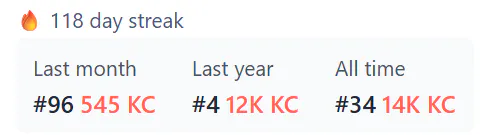
Product Hunt just added a new leaderboard and it finally answers a big question: who s actually contributing to the platform?
For a long time, Streaks were the main signal of activity on Product Hunt. But streaks only showed who visited every day. Opening the site or app daily doesn t necessarily mean someone is adding enough value.
I didn't know no-shows waste 15-40% of every sales team's calendar until I met a stranger at Web Summit. I was standing by our booth when someone wandered over and started asking about what we're building at @Meet-Ting. I assumed he was just curious. Then he mentioned his company loses a lot of time to no-shows across his sales team. I asked how many. "We get 10,000 inbound demos a month." He walked off eventually, and someone came over to me and said: "Do you know who that was?".
Turns out he was the Head of Sales at a European unicorn.
We stayed in touch. And that conversation became a feature! We call it 'No Show Recovery'. Ting watches your calendar. If it notices the other person didn't show up, it asks if you want help rescheduling - automatically, inside the same thread. When you're running 10k sales calls a month and 15-40% don't show, recovering even 1-5% is hundreds of meetings saved and potential $$$s. Other lesson, talk to people as if you want and expect nothing in return.
There's a pattern I keep noticing: the AI tools that actually get traction on PH aren't the swiss-army-knife platforms. They're the ones that nail one specific workflow end-to-end.
Been working on a few launches recently and this keeps proving true. What's the most focused AI tool you've come across lately?
This week, I went down a rabbit hole that started with World Sleep Day (yes, it's a thing) and ended somewhere between Swiss sleep retreats and a word game that mimics the brain's natural drift into unconsciousness.
A few things I didn't expect to find:
Hotels now have sleep doctors and overnight brain monitoring programmes, and a smart mattress company just hit a $1.5 billion valuation. Sleep has quietly become a luxury category.
Stanford Medicine researchers found that it's not just how long you sleep, but when. Your bedtime timing may matter more for your mental health than the number of hours.
A Canadian academic developed a technique called cognitive shuffling, which went viral on social media. The idea is to mimic hypnagogia, the transitional state between wakefulness and sleep, to trick your brain into switching off. Sleep specialists are paying attention.
AI agents are increasingly making real decisions in businesses. They qualify leads, respond to customers, analyze data, and sometimes trigger actions that affect revenue or customer experience. As these systems move from suggesting to actually deciding, mistakes become inevitable.
When that happens, responsibility becomes unclear. The user configured the system, the company built the product, and the underlying models often come from another provider. If an AI agent makes the wrong call and it impacts a customer or revenue, where should accountability actually sit?
Curious how others are thinking about this. Who should be responsible in such cases, and are there any legal guidelines or draft regulations emerging around this?
It doesn't need to be profound. Could be a question you Googled at 2 am, something a stranger said that stuck with you, or a topic you keep meaning to explore but haven't yet.
In my case, last week I found myself thinking about walking (a lot). It's my favorite hobby, but at some point, I realized I'd never actually looked into the science and psychology behind it. So I started wandering the internet for resources, and before I knew it, a whole newsletter edition had written itself.
We had our Product Hunt launch yesterday (thank you, everyone, for the support!), but the day before that, we decided to revamp the free trial page.
The initial version had a form with 5 questions outlined in a simple, straightforward way. The idea was simple: fill in the form, press generate, and see the posts. It was clear, but also... it didn't give you any visual cues or incentives.
We're super happy that PostGod is finally live on Product Hunt. Thank you for your support, feedback, and ideas
Because we want to continue today's launch celebration, we're keeping the 1 month 50% discount code throughout the week - available using the code PRODUCTHUNTERS.
If you re still sitting on your launch, this is the push.
YC made a special exception for this community: one or more companies that launch tomorrow will get a YC interview and potentially funding. A YC partner will review every eligible launch.