•
•3mo ago
The hidden problem with AI agents: they don't just answer, they act
For a long time, most AI conversations were about answers.
Could a chatbot write a better email? Summarize a document? Explain a concept? Even when the output was wrong, the result was usually a suggestion that a person could accept, reject, or ignore.
Agents change that dynamic a bit.
An AI agent might update a CRM, approve a workflow, modify a database record, send a message to a customer, or trigger actions across multiple systems. At that point, the conversation is no longer just about the quality of the answer. It's also about the consequences of the action.
•3mo ago
A simple AI governance checklist for your first production agent
A lot of agent projects spend months improving prompts, models, and workflows, then ship to production without asking a few fairly basic questions. Before trusting an AI agent with real work, I'd want clear answers to these:
1. What actions is the agent allowed to take?
Define the boundaries before deployment, not after.
2. Which tools and systems can it access?
Give access based on necessity, not convenience.
3. Are sensitive actions gated by approval?
Not every step needs review, but some decisions probably should.
4. Is there a record of what the agent did?
If something goes wrong, you should be able to reconstruct the sequence of events.
5. What happens when the agent is uncertain?
Low-confidence outputs need a clear path instead of silently moving forward.
6. Can you roll back mistakes?
Every production workflow should have a recovery plan.
7. Who owns the outcome?
At some point, a person needs responsibility for the workflow, even if an agent is doing most of the work.
None of these questions are particularly complicated. What's surprising is how often they only come up after an agent is already running in production.
What would you add to the list before trusting an agent in production?
•2mo ago
If your AI agent fails silently, who finds out first?
Imagine an AI agent responsible for routing inbound leads. Nothing crashes. No alerts fire. The workflow keeps running exactly as expected.
The problem is that the agent has slowly started sending high-value leads to the wrong queue. Maybe a few customer issues are being summarized inaccurately. Maybe records are being updated with small mistakes that seem harmless on their own. Each individual error is easy to miss. Over time, though, the impact starts to compound.
Those are the AI failures that interest me most because they rarely look like failures at first. There is no outage, no red warning message, and no obvious signal that something is wrong. The workflow continues operating, but the quality of the outcomes quietly drifts away from what the team intended.
That makes detection a different challenge altogether. It's less about system uptime and more about observation. Are there feedback loops? Quality checks? Escalation paths? Can someone spot a pattern before customers, revenue, or operations start feeling the effects?
•5mo ago
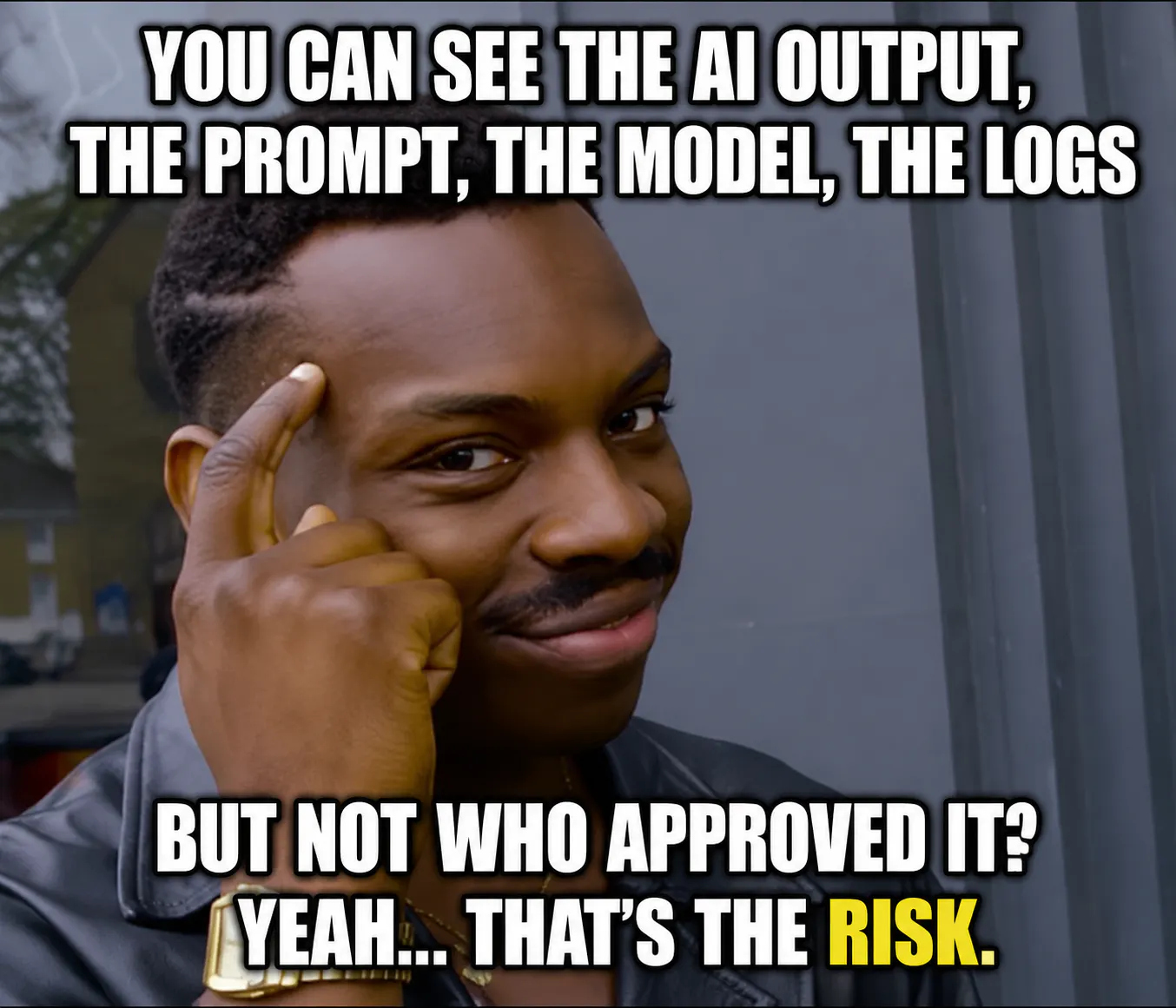
Would you trust an AI output if you could not see who approved it?
Been thinking about this after something that came up recently. Imagine an AI agent makes a recommendation that ends up influencing a customer workflow. The recommendation gets reviewed, approved, and eventually becomes part of how the team operates. Fast forward a few months and someone wants to understand why that decision was made.
The interesting part is that the technical history is usually still available. You can find the output. You can find the prompt. You can usually figure out which model generated it. What can be surprisingly difficult to find is the human context around the decision. Who reviewed the recommendation? Who approved it? What information did they have that made the recommendation seem reasonable at the time?
The more AI becomes part of everyday workflows, the more I find myself paying attention to that layer. Understanding the output matters, but understanding why someone trusted that output often matters just as much. A lot of conversations around AI accountability focus on the model. I suspect a lot of the missing context lives around the people making decisions with it.
Curious how your team is keeping track of that today, lets discuss it below...
 •
•2mo ago
AI agents need permissions the same way employees do
Most companies would never give a new employee unrestricted access to every system on their first day.
A new hire might get access to a few tools, a defined set of responsibilities, and additional permissions as trust is earned. Some actions require manager approval. Some systems are restricted entirely. That's not because the employee is untrustworthy. It's because access and responsibility usually grow together.
I've always found it interesting that AI agents are sometimes introduced with the opposite assumption. An agent gets connected to calendars, databases, internal documents, customer systems, and external tools all at once because technically it can use them.
The challenge is that capability and authorization aren't the same thing.
•3mo ago
OpenBox.ai is live with 7+ agent framework integrations
OpenBox.ai is live on Product Hunt today with major product updates!
We ve expanded OpenBox from a runtime governance layer into a framework-agnostic control layer that teams can use across their existing AI agent stack.
:
8+ integrations with Temporal, LangChain, LangGraph, CrewAI, Mastra, Deep Agents, CopilotKit, and n8n
•4mo ago
The boring AI topic that becomes important the moment your agent touches real customer data
I've never seen anyone get excited about governance during an ai agent demo.
When an AI agent is answering questions, booking meetings, or completing a workflow in a test environment, the conversation is usually about capabilities. How fast is it? How accurate is it? Can it handle more tasks?
The tone tends to change once the same agent is connected to customer accounts, internal systems, or business data. Suddenly people want to know who can access what, whether actions can be reviewed later, and how mistakes get handled when the outcome affects a real person instead of a test case.
What's interesting is that the technology often hasn't changed very much. The model is the same. The workflow is similar. The difference is that the consequences are now real.
•2mo ago
The 5 governance questions every AI founder should answer before launch
I've noticed that most founders spend a lot of time asking whether an AI agent works and much less time asking what happens after people start relying on it.
Before launching, I'd want clear answers to five questions:
1. What can the agent access?
Data access tends to expand over time. It's worth knowing exactly which systems, documents, and information sources are within reach.
•5mo ago
Should AI governance include decision ownership?
Something I've been thinking about recently:
Let's say an AI agent makes a recommendation and that recommendation ends up influencing a real business decision. A few months later, someone wants to understand why that decision was made. In most cases, it's not that hard to find the model, the prompt, or the output. Teams are getting much better at tracking those things.
What feels harder is understanding what happened in between. Who reviewed the recommendation? Who approved it? What information were they looking at when they decided to move forward with it?
Maybe there was a conversation that wasn't documented. Maybe there was context that seemed obvious at the time but wasn't recorded anywhere. Maybe there were reasons for trusting the recommendation that never made it into a system.
I keep coming back to this because the output is only one part of the story. The decision happens when a person looks at that output and decides what to do next. If that context disappears, it becomes much harder to understand how a decision was made, even when the AI history is still available.
Curious how other teams are thinking about this.
•4mo ago
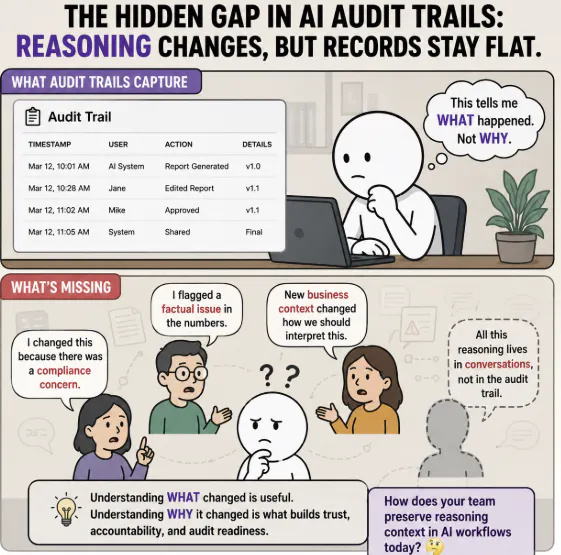
The hidden gap in AI audit trails: reasoning changes, but records stay flat.
One thing I've noticed with AI audit trails is that they tend to do a good job of recording events but not always the reasoning behind them.
Take a simple example: An AI-generated report goes through an internal review before being shared with customers or stakeholders. Someone makes edits, approves the final version, and the workflow moves forward. Months later, if you look back, the audit trail will usually tell you when the changes happened, who made them, and which version was approved.
What it may not tell you is why those changes were made in the first place. Maybe there was a compliance concern. Maybe someone spotted a factual issue. Maybe additional business context changed how the output was interpreted. The record captures the action, but not necessarily the thinking behind it.
The more I look at AI governance, AI accountability, and audit readiness, the more this feels like an important gap. Understanding what changed is useful. Understanding why it changed is often what helps teams make sense of a decision months later.
Curious how teams are preserving reasoning context across AI workflows today, especially when outputs move through review, edits, and approvals.
Lets chat