
 •
•8mo ago
Idea Usher Review: GURARIDE — A Practical Bike & E-Scooter Sharing App
Most mobility apps try to do too much. Some overload users with features. Others focus only on growth without solving real transport friction. In both cases, daily commuters eventually stop using them.
In this Idea Usher review, an independent technology services reviewer evaluates GURARIDE, a bicycle and e-scooter renting platform operating across Rwanda. The goal is not promotion or hype. Instead, this review looks at the system from a builder s perspective to understand how well the product solves actual first- and last-mile mobility problems.

 •
•4mo ago
Can a SaaS still survive without AI in 2026?
I think yes - but only if it solves a real problem well enough that people actually care about the product. A lot of products are adding AI because they feel like they have to. But if the core workflow is still messy, confusing, or not that useful, AI does not fix the product.
I m building PrepIt for coffee shop operations, and this is something I think about a lot. Maybe for some products, AI can be a real advantage. For others, clarity, reliability, and solving a very specific problem still matter more.
Curious how other founders see it:
Is AI now a requirement, or can niche SaaS still win by being focused and practical?
Also drop your no-AI project if you have one!
 •
•4mo ago
Jobply helps job seekers apply faster without losing their mind.
I built Jobply because applying to jobs has become weirdly broken endless forms, fake-looking listings, repeated profile fields, and no real feedback.
Right now it helps with:
finding fresh jobs
matching roles to your profile
autofilling applications
generating tailored resumes, cover letters, and application answers
It started as a tool for job seekers, but we re also testing a recruiter-side flow where companies can describe a role and get matched with candidates who are actually interested.
 •
•8mo ago
Need feedback from AI Agent builders
 •
•4mo ago
This week at QueueForge wasn't about launching new features.
Instead, we focused on something less visible but just as important: migrating our infrastructure to new servers and improving the foundation of the platform.
We also spent time refining the product, discussing design decisions, and planning the next stage of development.
Building a product isn't always about shipping. Sometimes it's about making sure the foundation is ready for what's coming next.
 •
•4mo ago
I bought replyay.com what micro-SaaS would you build around "AI" & "Replies"?
Hey everyone
I recently bought replyay.com and I'm thinking about turning it into a small SaaS around AI-powered replies.
The name felt simple, friendly, and easy to remember, so now I'm exploring what direction to take with it.
Would love to hear your honest thoughts from other builders here.
Does the name feel useful for a product? Would you click on something called Replyay?
 •
•4mo ago
Early look at RunEvr: a workspace built for creatives - would love feedback
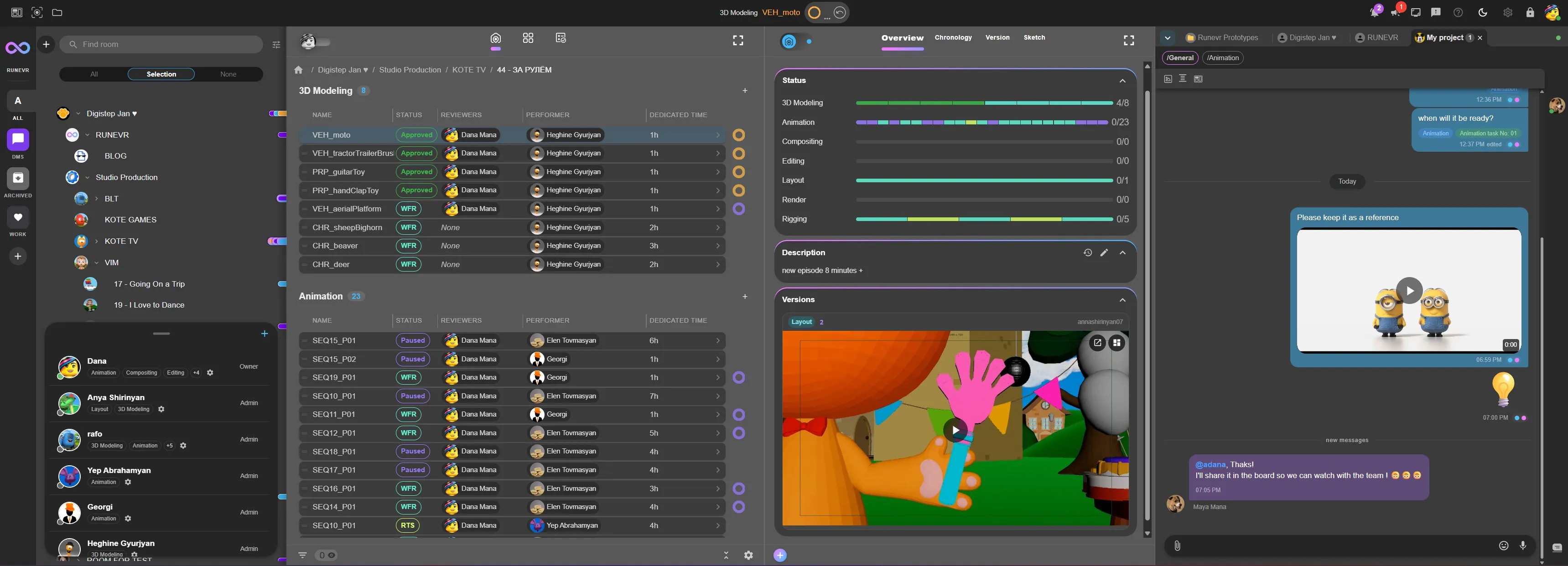
Hello PH!
I'd love to share a screenshot of the current version of RunEvr and get some feedback.
 •
•4mo ago
The crypto AI assistant that reads the chain before it answers
Hey Product Hunt, I am the solo founder behind TxDesk.
I built it around one idea: in crypto, a confident wrong answer costs you your wallet. A general AI model answers from training data with no live view of the chain, so it autocompletes something fluent and possibly wrong. When the cost of being wrong is your money, the model cannot be the source of truth. The chain has to be.
 •
•4mo ago
Feature Updates for oneinfer-edge
Hardware checks. Compatibility scans. Model deployment. Copilot routing. Local hosting. Multi-cloud instances. Cloud failover. Used to take a day. Now under 10 minutes.
AI moves fast. Deployment doesn't. 40% of teams take more than a week to get a single model into production. Data scientists spend over a quarter of their working day on setup, not science.
That's not an AI problem. That's an infrastructure problem.
oneinfer-edge fixes it. Not by reinventing the stack. By orchestrating what already exists into one open source control plane.
- Multiple serving libraries. One scan.
Ollama, llama.cpp, vLLM, SGLang, TensorRT-LLM, PyTorch, Dynamo. Instead of manually testing each one against your model and hardware, oneinfer-edge evaluates all five simultaneously and tells you exactly which one to use, for local, cloud, or both. Hours of trial and error eliminated before a single deployment.
- Traffic control panel for agentic harnesses. Zero code changes.
You can now leverage locally deployed models through the existing agentic copilots like codex, kilocode, opencode and openclaw and more upcoming.
-Model, serving library and hardware compatibility. Before you deploy.
Wrong serving library for your hardware. Wrong runtime for your model. These failures usually show up mid-deployment. oneinfer-edge runs a full compatibility scan across your model, your serving libraries, and your local hardware upfront. Complete picture. No surprises.
- Model and hardware resource checks. Local and cloud.
Paste any HuggingFace model ID. oneinfer-edge computes model weights, KV cache, and serving library overhead together and tells you whether it fits your machine or which cloud instance makes sense when local is not enough. No wasted downloads. No failed runs.
- Cloud instances marketplace. One API for everything.
Spin up instances across any cloud provider from the same control plane using a single OpenAI-compatible API. No switching between platforms. No managing separate configurations per provider. One place to create, manage, and monitor, regardless of which cloud you choose.
- Hybrid routing. Local, cloud, or both. Optimised automatically.
Local handles volume. Cloud handles complexity. When local capacity is exceeded, traffic fails over automatically. Routine tasks stay local. Complex reasoning goes to the cloud only when needed. Inference already accounts for 80 to 90% of the lifetime cost of a production AI system. Intelligent routing alone cuts that by 30 to 60%. Local-first hybrid orchestration pushes further.
We are just getting started. More coming in the next few days. Stay tuned!!!
Repo: https://github.com/oneinfer/onei...
Star it. Fork it. Consider contributing to the community.