
Launched this week

Blood Sugar Journal
AI-powered diabetes tracking for the modern era.
168 followers
AI-powered diabetes tracking for the modern era.
168 followers
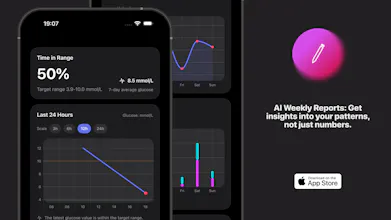
Managing diabetes shouldn't feel like a chore. Blood Sugar Journal uses AI (GPT-4o-mini) to turn raw glucose & insulin data into clear, actionable reports. Built for iOS 26 with a focus on speed, beautiful design, and seamless iCloud sync. 📉🚀



minimalist phone: creating folders
One of the best usecases of tech I can see is in the medicine. I would wish to have more similar tools that help with quality of personal life :) Wishing a successful launch :)
Blood Sugar Journal
@busmark_w_nika Hey Nika,
Thank you so much — really appreciate your words.
I completely agree. When technology is used carefully in healthcare, it can genuinely improve everyday life, not just add more noise.
With this app, I’m trying to keep things simple and useful — focusing on clarity, patterns, and reducing mental load rather than overwhelming people with features.
Thanks again for the support, it really means a lot 🙌
Blood Sugar Journal
Huge congrats on getting this out @dmitry_mashkin! We need more applications of AI in the medical field.
I've been advising a few healthcare startups and the iCloud sync piece is often where apps fall short, so glad to see you prioritized that from the start.
BTW, how does the AI actually interprets patterns in glucose data... does it factor in things like meal timing or exercise when generating those reports?
Blood Sugar Journal
@rohanrecommends Thank you so much, really appreciate it.
And yes, totally agree — sync is one of those things people don’t notice until it breaks, so I wanted to make sure it’s reliable from the start.
Regarding AI — right now it looks at the data in context: glucose entries, timing, and user logs like meals and insulin. The goal isn’t to “predict” or give medical advice, but to surface patterns that might not be obvious at first glance.
Things like timing (for example, how glucose behaves after meals or at certain times of day) are already part of the analysis. As more structured data is added — like exercise — the system can incorporate that context as well.
I’m trying to keep it careful and grounded: more about observation and clarity, less about conclusions.
@dmitry_mashkin How are you thinking about Apple Health integrations for seamless CGM data pull and trend spotting?
AgentReady
Hi Dmitry,
I really love your idea! My girlfriend has diabetes.
So I will definitely need something like this. One thing I don't understand is:
she has a sensor on her arm, how can she connect it to the app?
For people with diabetes it's already annoying to have a sensor on their arm, so she will never enter data manually into your app.
I would love to help you build this app, how can I contribute?
Blood Sugar Journal
@christian_b_1 Hey Christian,
Thanks a lot for your message — I really appreciate it.
I know type 1 diabetes not just from the outside, so I care a lot about making this app feel as simple and low-friction as possible.
And yes — you’re absolutely right about the sensor. Manually entering everything would be exhausting, and that’s not the experience I want to build. I’m planning to add Apple Health integration so glucose data can be pulled automatically from supported devices, leaving only insulin and meals to log manually.
I’ve also been very careful with the AI part. It’s included in the subscription, but it’s designed to stay cautious: no reckless advice, no pretending to replace a doctor. Its role is to observe data and highlight possible patterns. There’s also a local on-device algorithm that looks for patterns too, just in a more basic and structured way.
If you’d like to help, that would honestly mean a lot. Right now the most valuable support is real testing and honest feedback from people who understand this space.
Would love to have you involved.
I have one question, how does the tracking works, I mean we still need to have a glucose monitor attached right?
Blood Sugar Journal
@nayan_surya98 Great question.
Yes — you still need a glucose monitor or sensor to get the actual readings.
Right now, the app works as a clean journal where you can log glucose values, insulin, and meals in one place. I’m also planning to integrate with Apple Health, so data from supported sensors can be imported automatically.
The goal is to reduce manual work as much as possible and focus on clarity and patterns rather than just raw numbers.
Congratulations on the launch! Being a health-tech app, I'm wondering if you had to worry about any HIPAA, PII, etc. and if you had to store the data in the cloud that complies with those regulations? I'm interested in the tech you ended up going with, as it's a space I looked at and didn't go deep in because of the mess with handling some of the sensitive data. My idea didn't involve any provider or insurance integration or medical payments, I was told based on my research that it doesn't fall under HIPAA, or other medical regulations but there are other pointers that warn me to be careful with and so I'm still debating and wondering how you handled it.
How do you decide what goes into the AI reports vs what stays as raw data? I've been thinking about this with apps that deal with daily logging. There's a fine line between surfacing useful patterns and showing people so much analysis they stop trusting their own read on their numbers.