
Launched this week

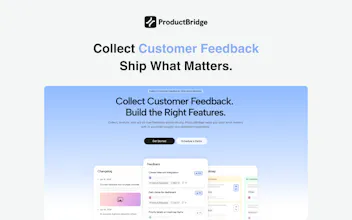
Your feedback is everywhere — Slack threads, Intercom support tickets, review sites, DMs. ProductBridge's AI agent collects it all automatically, organizes it, deduplicates, and helps your team ship what users actually want. Users request features, upvote, and watch ideas move through your public roadmap. Teams prioritize with data, publish changelogs, and auto-notify users when their feature ships. One platform. Complete feedback loop. Flat pricing. No seat fees. No surprises. Ever.





This is a very interesting idea. In our business, we receive a lot of feedback from multiple channels that never really gets processed as data as such, so this idea could actually be relevant, but I have a couple of doubts that came to mind:
The actionable insights sound great, but how does the app process contradictory feedback from clients to decide which side to lean to? Is there a process of prioritizing certain types of feedback over others? It would be super interesting to get a bit more info about this.
Anyways, congratulations for the launch!
ProductBridge
@carlos_alfredo_davila_aguilar Thank you! Really glad it resonates.
On contradictory feedback: ProductBridge doesn't pick a side automatically. Instead it shows you the full picture — how many people said what, and who they are. That context is what helps you make the call.
On prioritization: it's not just vote counts. You can tag users with properties like MRR or plan type. So if 10 free users want one thing and 3 paying customers want the opposite, you can see that clearly and decide what actually matters for your business.
The goal is to give you better information. 🙌
@hareesh_vemasani Thanks for your reply Hareesh! This actually clarifies my doubt.
ProductBridge
@hareesh_vemasani Curious how the dedup handles feedback from non-technical users where the same issue gets described in completely different terms, like one person says "it's slow" and another says "keeps timing out." Does intent-matching work reliably there too?
ProductBridge
@olia_nemirovski Great example — and yes, exactly the kind of case our dedup is built for. “It’s slow” and “keeps timing out” share zero common words but describe the same underlying problem. Our RAG + LLM matches by intent, not wording — so those two get grouped correctly.
Visla
@hareesh_vemasani Congrats on this lunch, wish you well!
Banyan AI Lite
Happy launch team! Quick question: How do you handle context and prioritization when aggregating feedback from so many different sources? For example, how do you distinguish between loud but low-impact requests and signals that actually represent broader customer demand, and how reliable is the deduplication when similar feedback is phrased differently across channels?
ProductBridge
Thanks for the kind words, and great questions,@davitausberlin
On prioritization: we don't just count votes. Every user in ProductBridge can be tagged with properties — like the MRR they bring in, their plan type, or any custom attribute. So when feedback comes in, you're not just seeing how many people asked — you're seeing the weight behind who asked. A request from 3 high-MRR customers can and should outrank 20 requests from free users.
On dedup across channels: we use advanced RAG + LLM, so matching happens at the intent level, not keyword level. And the AI already knows your full context — knowledge base, existing feedback, roadmap, and changelog. So the same problem phrased differently across Slack, Intercom, and email gets grouped correctly.
Congrats on the launch! How does ProductBridge handle conflicting signals? (example: when a feature is largely recommended by free users but paying customers never mention it). Does AI score accounts by revenue impact, or is prioritization purely vote-based?
ProductBridge
Thanks for the support, @alina_petrova3
Pure vote counts are honestly one of the most misleading signals in product.
ProductBridge is not just vote-based. When you collect feedback, you can attach user properties like MRR or revenue to each user. So when a feature gets 50 votes from free users and very few votes from your top paying customers, you see that context clearly — and can weigh it accordingly.
The goal is to make sure your roadmap reflects business impact, not just headcount. As a product manager, you can sort by both upvotes and revenue to make better decisions. 🙌
The "closing the loop" part is what I care about most here. We've tried a couple feedback tools before and the collection part is usually fine, but actually telling users "hey we shipped the thing you asked for" always falls through the cracks.
$24/mo flat is solid too. Most tools in this space charge per seat which gets painful fast when you want the whole team to have access.
How does the AI handle feedback that's more of a rant vs an actual feature request though? That's always been the tricky part for us.
ProductBridge
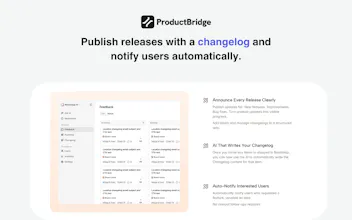
@mihir_kanzariya The loop-closing problem is exactly why we built the changelog + notifications the way we did — it's automatic. Ship a feature, every user who asked gets notified. Zero manual effort.
On rants: the AI reads the frustration and pulls out the real problem underneath. Actionable signal, not noise.
And yes — flat pricing, whole team, no surprises unlike most of the feedback management platforms out there.
Uploadcare
Congrats on the launch! But how is it different from, say, ProductBoard, Canny, airfocus, and the likes?
ProductBridge
Thanks @janeph! Great question.
ProductBoard, Canny, airfocus — they're solid tools. But they're mostly built around manually organizing feedback. You still do a lot of the heavy lifting.
We're built AI-first, from the ground up. Here's what that looks like in practice:
— When someone submits feedback, AI flags similar posts in real time before it's even created
— Incoming feedback gets auto-tagged and categorized, no manual sorting
— When feedback comes in from Slack, Intercom, or support tickets, AI deduplicates it against everything already in your knowledgebase, feedback boards, roadmap, and changelog
— When you ship, AI writes your changelog for you
The goal is simple: your team should never have to deal with a duplicate request, a messy board, or a blank changelog again. That's the gap we're filling.
And flat pricing. Whole team, no per seat pricing, no surprises. Ever. 🙌
Trufflow
One of my biggest challenges with customer feedback is trying to filter out which ones were real feedback and which ones were from bots/fake. Are there ways that ProductBridge help with this?
ProductBridge
Great question @lienchueh — and a real problem more teams face than they admit.
Our AI is trained to tell the difference between genuine feedback and noise — bots, spam, or just random chatter that sneaked in. In most cases it flags and filters automatically. When it's not confident enough to decide on its own, it puts it in a manual review queue so nothing gets wrongly discarded.
So your board stays clean without you having to babysit every submission. 🙌