•
•4mo ago
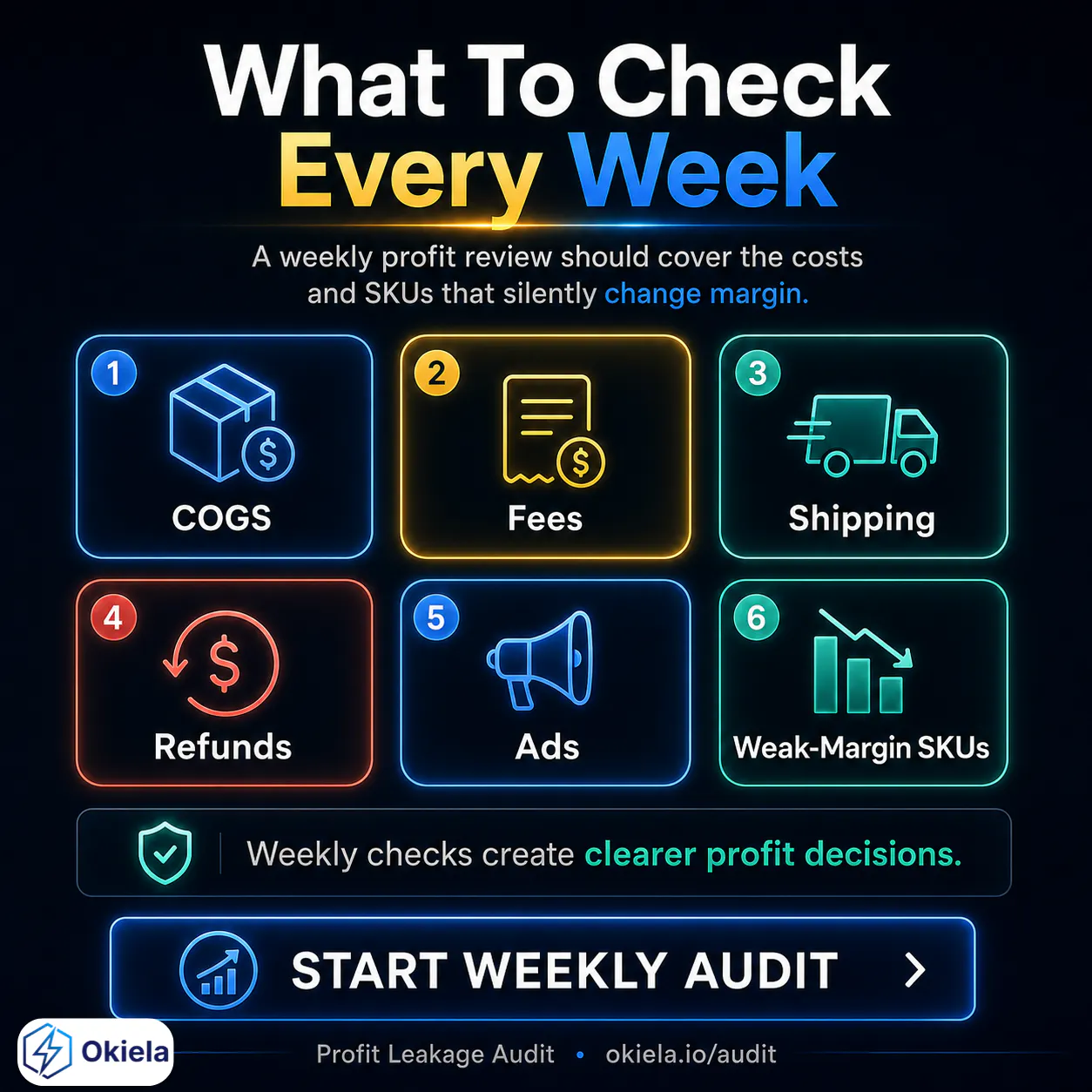
When to Outsource Ecommerce Operations (And When to Keep Them In-House)
One of the quiet traps in ecommerce:
doing everything yourself feels like saving money.
Packing orders.
Answering tickets.
Updating spreadsheets.
Chasing product photos.
Checking ads.
Fixing small operational issues.
It feels responsible.
But at some point, the question changes.
It is no longer:
Can I do this myself?
It becomes:
Is this the best use of founder time?
Because a founder spending 10 hours a week on low-leverage tasks is not free.
That time has a cost.
A simple test I like:
Take any task and ask:
What does this task really cost me in time?
What would happen if I used those hours on pricing, product, customers, or growth instead?
Can someone else do this repeatably without hurting quality?
Can I still measure the impact clearly?
That last question matters a lot.
Outsourcing is not just a time-saving decision.
It is also a visibility decision.
A 3PL can help fulfillment.
A support partner can reduce inbox pressure.
An agency can move faster on ads or email.
But once the work moves outside the business, the numbers often become harder to connect.
Shipping costs live in one system.
Returns live in another.
Ad spend sits somewhere else.
COGS is still in a sheet.
Vendor invoices show up later.
And the founder is left asking:
Are we actually more profitable now?
That is the part I think founders should protect.
Outsource the task.
Do not outsource your understanding of the business.
The work can move outside.
But profit clarity has to stay close.
Read more detail: https://okiela.io/blog/when-to-o...
 •
•2mo ago
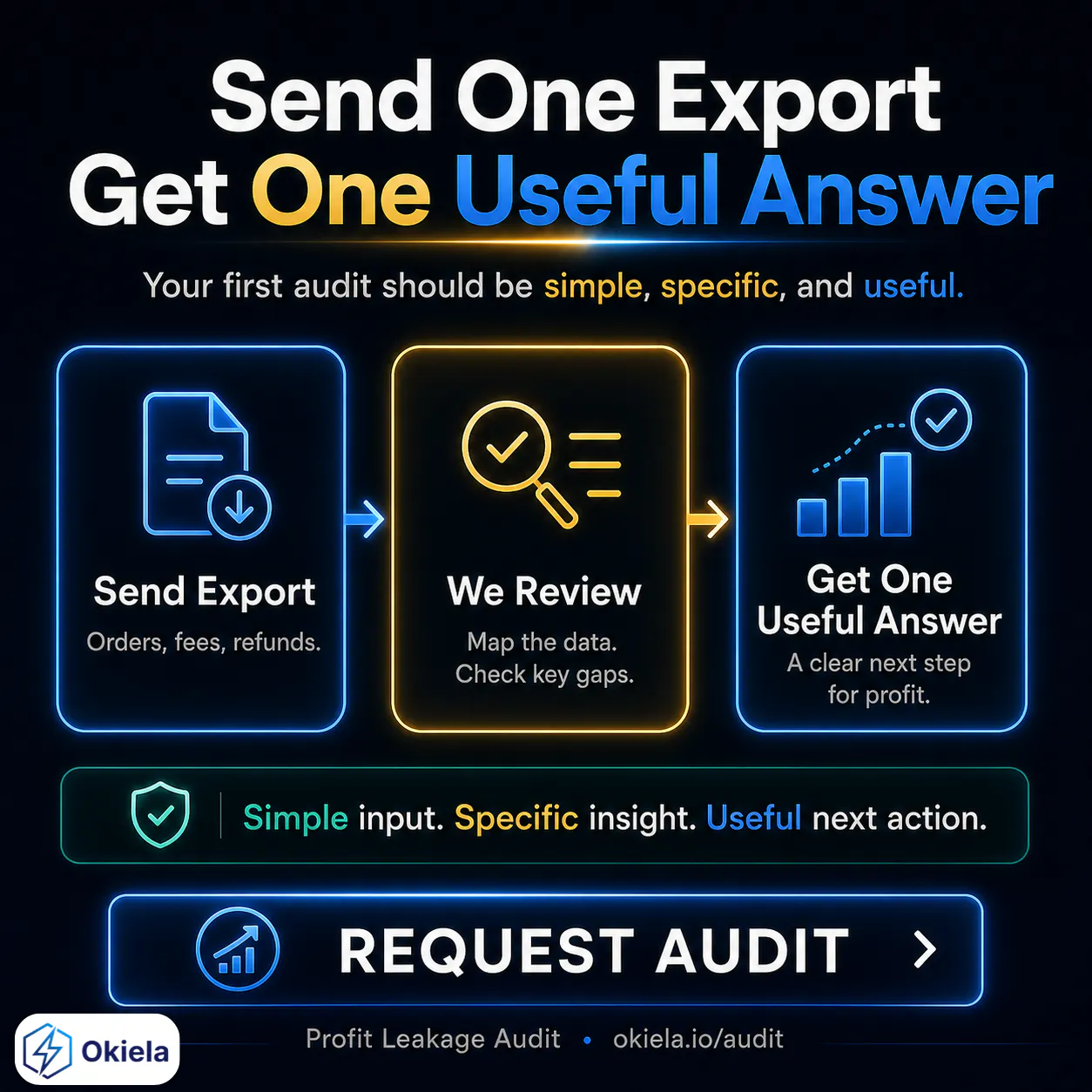
Send one order export. Get one useful answer !
Send one export. Get one useful answer.
That is how the first Okiela audit should feel.
Not a heavy onboarding process.
Not another dashboard to learn.
Not a vague growth report.
Not fake certainty.
Just one practical profit question:
Where is this store leaking profit?
The first review should be simple:
* send one order export
* map the important fields
* check cost layers
* identify what is verified, estimated, or missing
* return the clearest profit leaks
Maybe the issue is COGS.
Maybe shipping cost is eating margin.
Maybe refunds are changing the SKU story.
Maybe discounts are making revenue look better than profit.
Maybe ad spend is missing, so POAS cannot be trusted yet.
The first audit does not need to answer everything.
It just needs to give you one useful direction.
#EcommerceProfit #ProfitLeakage #ShopifySeller #Okiela
 •
•3mo ago
Why does mapping matter so much?
Why does mapping matter so much?
Because one wrong column can change the whole profit story.
In ecommerce, an order export may look simple.
But if SKU, quantity, discounts, refunds, shipping, fees, taxes, COGS, or ad spend are missing or mapped incorrectly, the profit analysis becomes unreliable.
A few common file issues:
* SKU column is blank or inconsistent
* discounts are mixed into revenue
* refunds are not separated clearly
* shipping charged and shipping cost are confused
* COGS is missing or outdated
* order IDs do not match across files
* ad spend is not connected to the right period or channel
This is why profit clarity starts with data mapping.
Not because mapping is exciting.
Because bad mapping creates bad decisions.
Okiela s first audit is designed to find profit leaks, but also to show what is verified, estimated, or missing.
#EcommerceProfit #Okiela #ProfitLeakage #Shopify
 •
•3mo ago
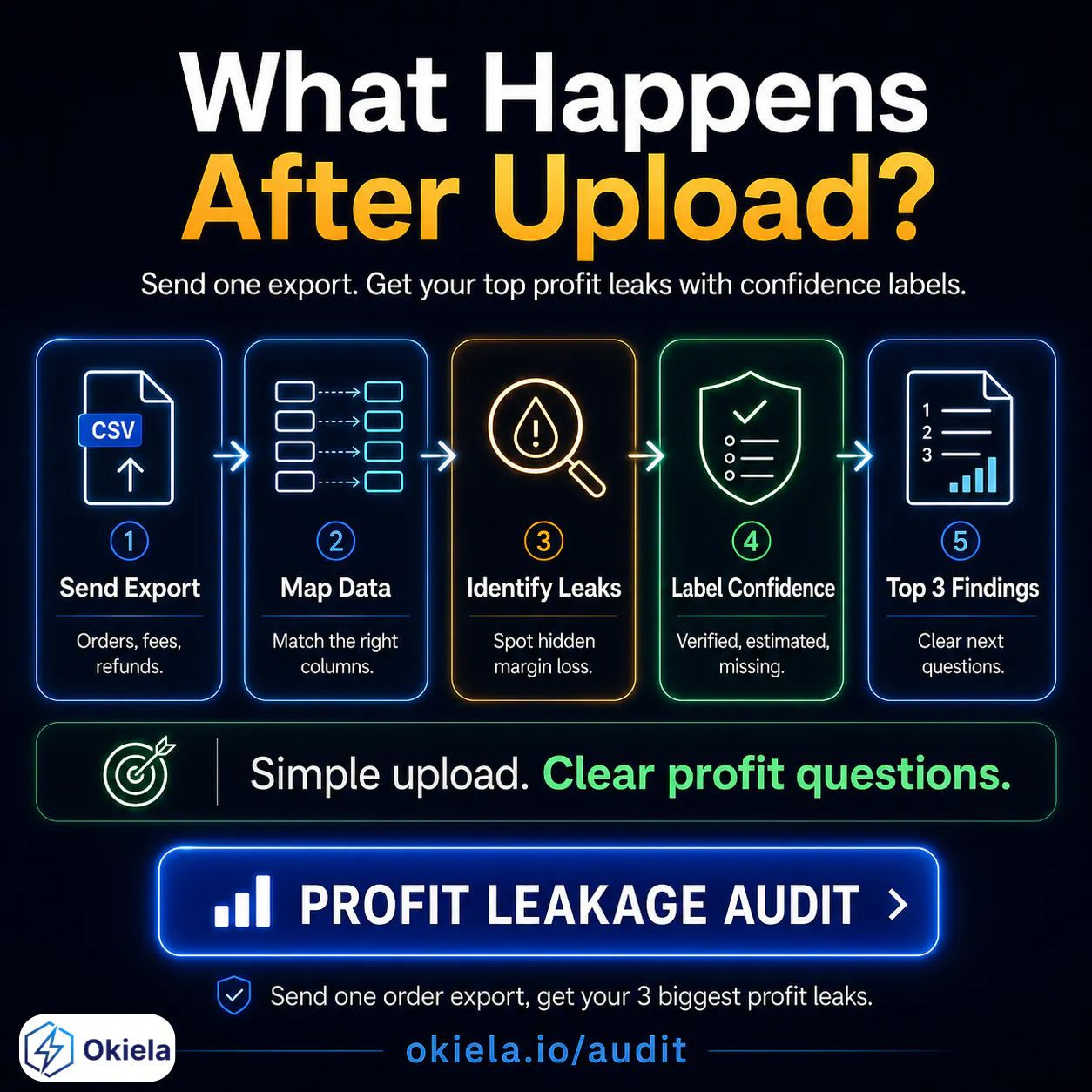
What happens after I upload my export ?...
What happens after I upload my export?
Good question.
The first Okiela audit is designed to stay simple:
1. You send one order export
2. We map the important fields
3. We check the cost layers
4. We identify possible profit leaks
5. We label what is verified, estimated, or missing
6. You get your top 3 findings back
The goal is not to overwhelm you with another dashboard.
The goal is to answer a useful question:
Where is profit quietly leaking in this store?
Sometimes the leak is COGS.
Sometimes it is shipping.
Sometimes it is refunds.
Sometimes it is discounts.
Sometimes it is a SKU that sells well but keeps weak margin.
The first audit should be clear, practical, and useful.
#EcommerceProfit #ProfitLeakage #ShopifySeller #Okiela
 •
•3mo ago
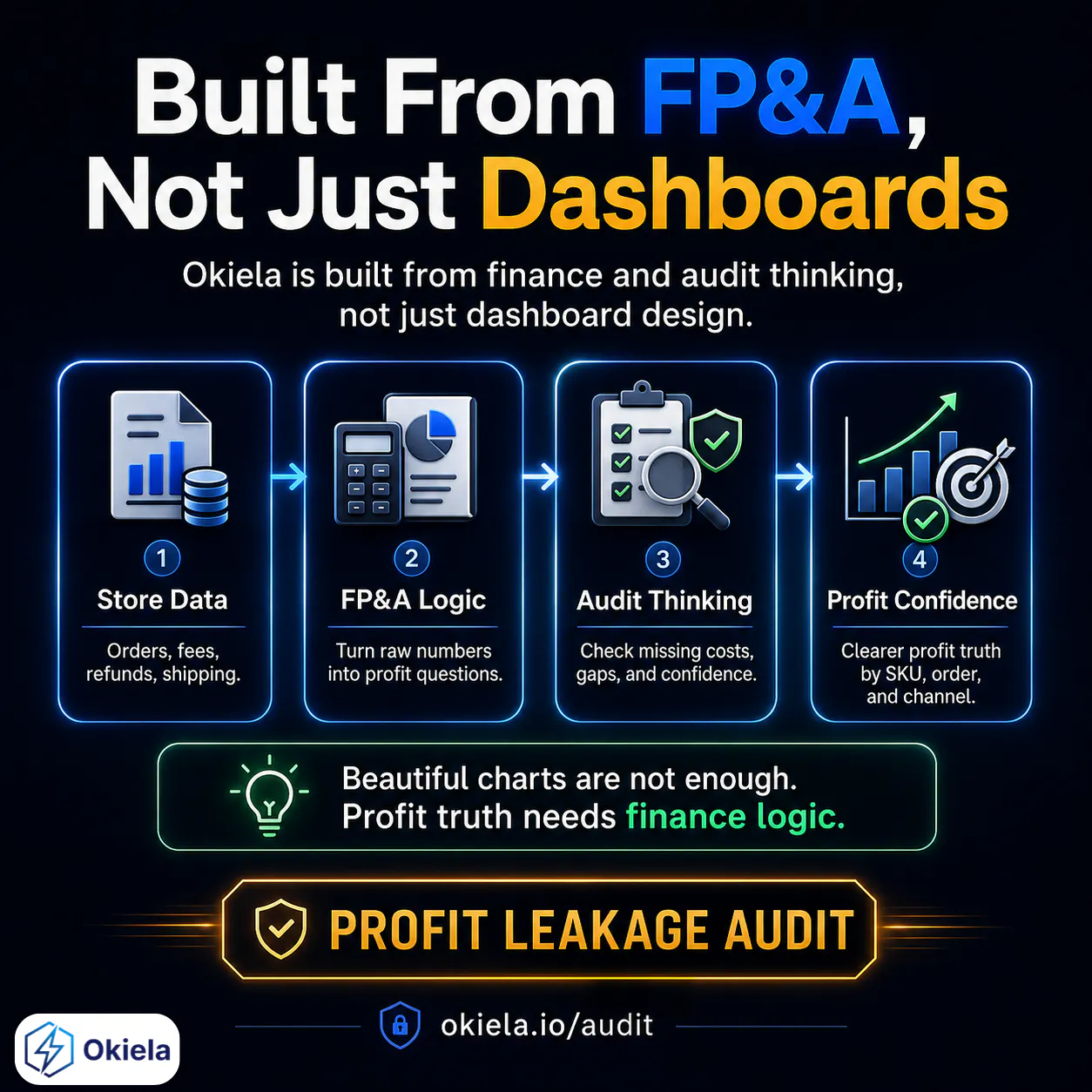
Okiela is NOT built from DASHBOARD thinking first
Okiela is not built from dashboard thinking first.
It is built from finance and audit thinking first.
Before building Okiela, my background was in FP&A, finance, and internal audit.
That shaped how I think about ecommerce numbers.
A dashboard should not only look clean.
It should help answer uncomfortable business questions:
* Is this SKU actually profitable?
* Which cost layer is missing?
* Which channel keeps less profit than expected?
* Is this number verified, estimated, or incomplete?
* Are we making decisions from revenue or true profit?
That is why Okiela is designed around proof, not just presentation.
Revenue alone is not enough.
ROAS alone is not enough.
A beautiful chart alone is not enough.
Ecommerce sellers need profit clarity they can inspect, explain, and act on.
That is the reason I am building Okiela.
#EcommerceProfit #EcommerceAnalytics #ProfitLeakage #Okiela
 •
•3mo ago
Why did yesterday’s winner change?
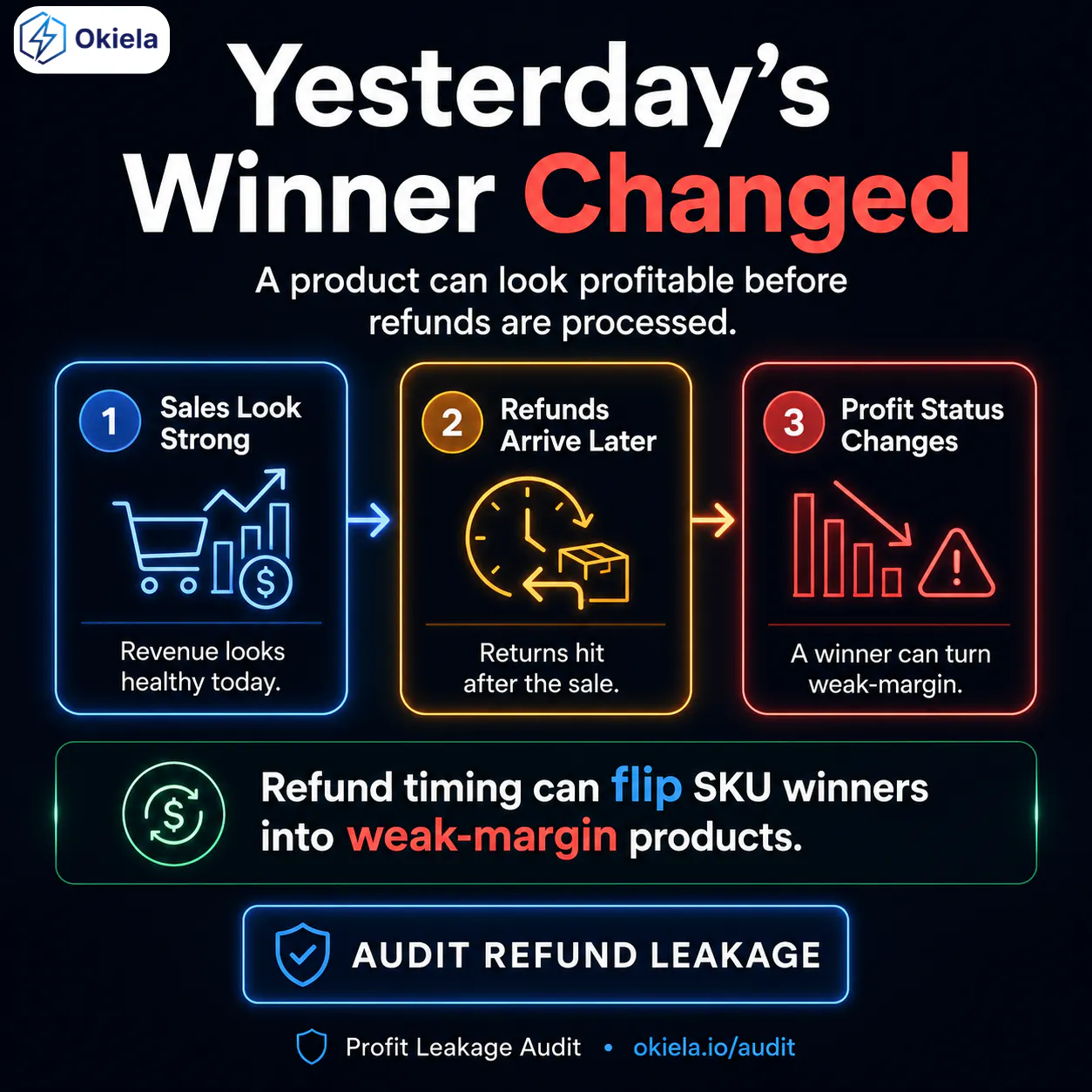
Why did yesterday s winner change?
Because ecommerce profit is not final the moment an order is placed.
A product can look strong today.
Then refunds arrive tomorrow.
Returns get processed later.
Shipping adjustments appear after fulfillment.
Fees may settle after the sale.
This is why yesterday s best product can become today s weak-margin SKU.
The product did not magically change.
The full cost picture arrived late.
A common mistake is making fast scaling decisions from early revenue before refunds are fully reflected.
Revenue is instant.
Profit often needs timing context.
Okiela helps sellers look beyond the first sales view and identify where refunds are quietly changing SKU, order, and channel profit.
#EcommerceProfit #ProfitLeakage #UnitEconomics #Okiela
 •
•3mo ago
Why did yesterday’s winner change?
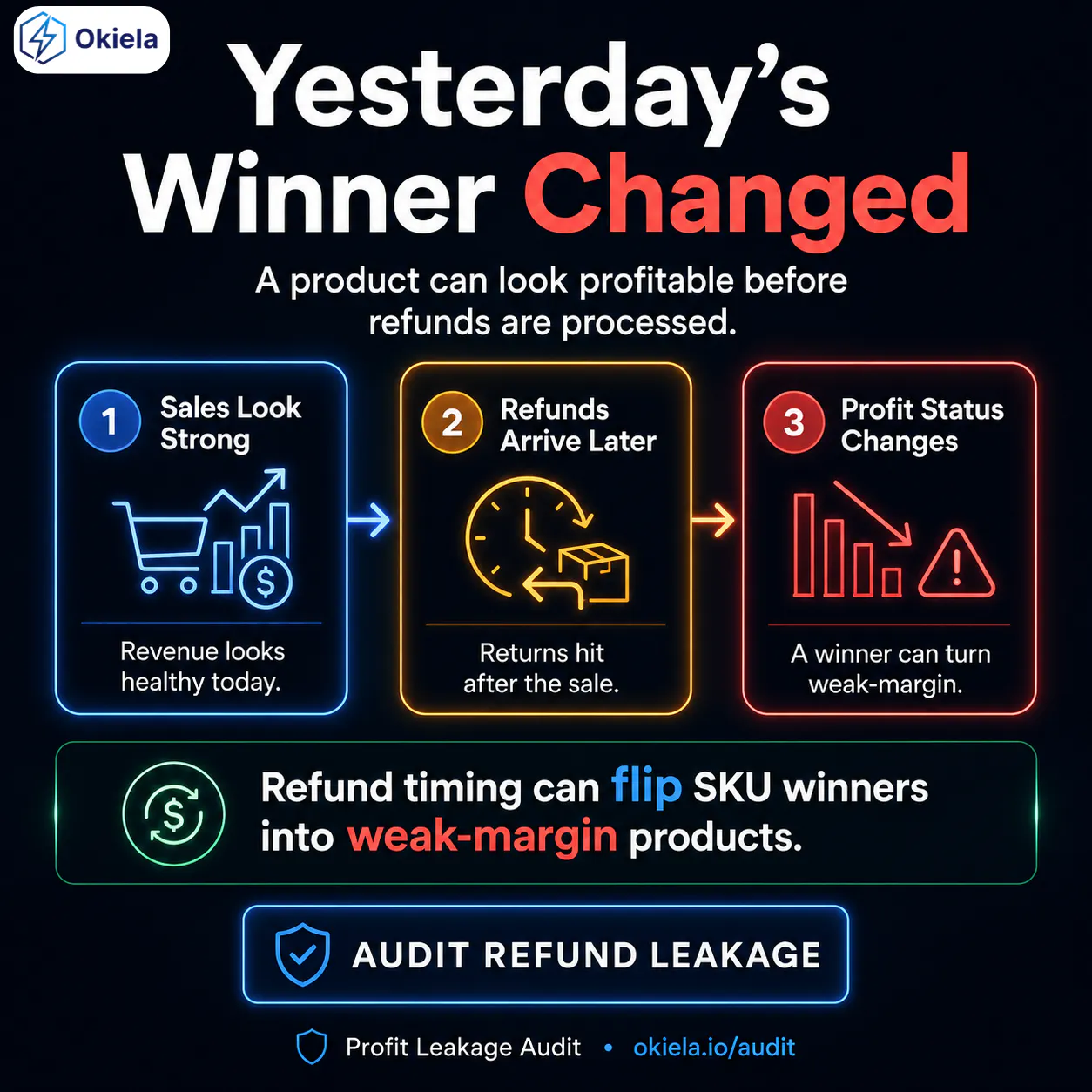
Why did yesterday s winner change?
Because ecommerce profit is not final the moment an order is placed.
A product can look strong today.
Then refunds arrive tomorrow.
Returns get processed later.
Shipping adjustments appear after fulfillment.
Fees may settle after the sale.
This is why yesterday s best product can become today s weak-margin SKU.
The product did not magically change.
The full cost picture arrived late.
A common mistake is making fast scaling decisions from early revenue before refunds are fully reflected.
Revenue is instant.
Profit often needs timing context.
Okiela helps sellers look beyond the first sales view and identify where refunds are quietly changing SKU, order, and channel profit.
Send one order export, get your 3 biggest profit leaks.
 •
•4mo ago
Shipping cost is one of the easiest places for ecommerce profit to disappear quietly...
Shipping cost is one of the easiest places for ecommerce profit to disappear quietly.
Not because founders ignore it.
Most founders know shipping is expensive.
The problem is that shipping often gets treated like an operations detail, not a profit decision.
But it affects almost everything:
conversion,
AOV,
gross margin,
cashflow,
returns,
customer expectations,
and whether free shipping actually makes sense.
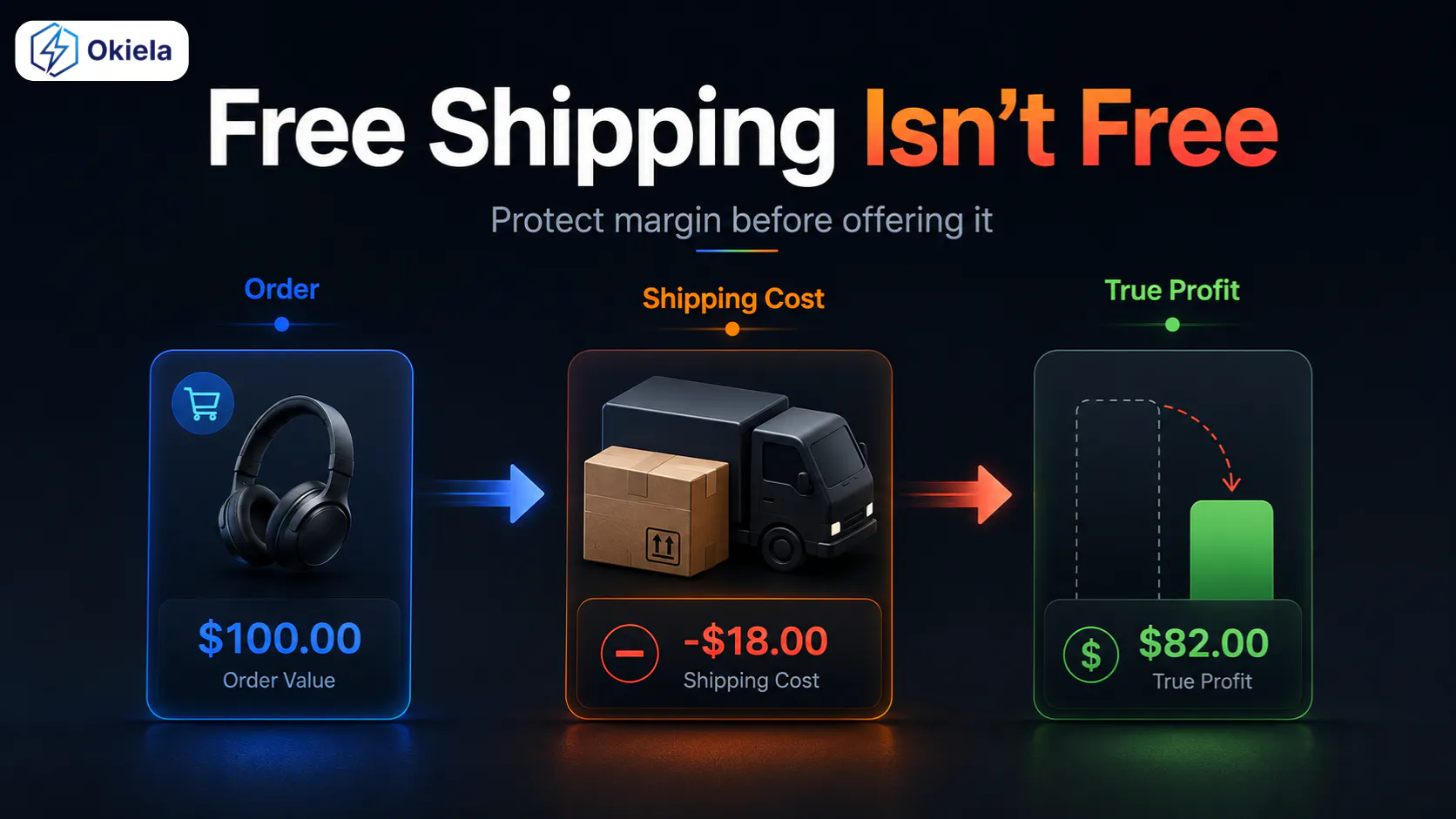
A free shipping offer can increase conversion.
But it can also quietly turn a good order into a weak one.
A flat shipping rate can feel simple.
But it may hide losses on heavier or lower-margin products.
A free shipping threshold can lift AOV.
But only if the extra items actually cover the shipping cost.
That is why I think shipping should not be optimized in isolation.
It should be connected to SKU margin, order value, product weight, return risk, and customer behavior.
Before changing shipping strategy, I d ask:
Which products are shipping-heavy?
Which SKUs lose margin after shipping?
Does free shipping improve profit or only revenue?
Is the free shipping threshold set above the real break-even point?
Are we subsidizing unprofitable orders?
Can packaging reduce dimensional weight?
Can we separate shipping rules by product, region, or order value?
The goal is not always the cheapest shipping.
The goal is shipping that protects conversion without quietly destroying profit.
That is the layer I want Okiela to make clearer:
not just shipping cost is high,
but:
which orders are affected,
which SKUs are leaking margin,
what threshold makes sense,
and what action should be checked first.
Because shipping is not just a logistics problem.
It is a margin problem.
#ecommerce #shopify #profitability #shipping #dtc #unitEconomics #Okiela
 •
•3mo ago
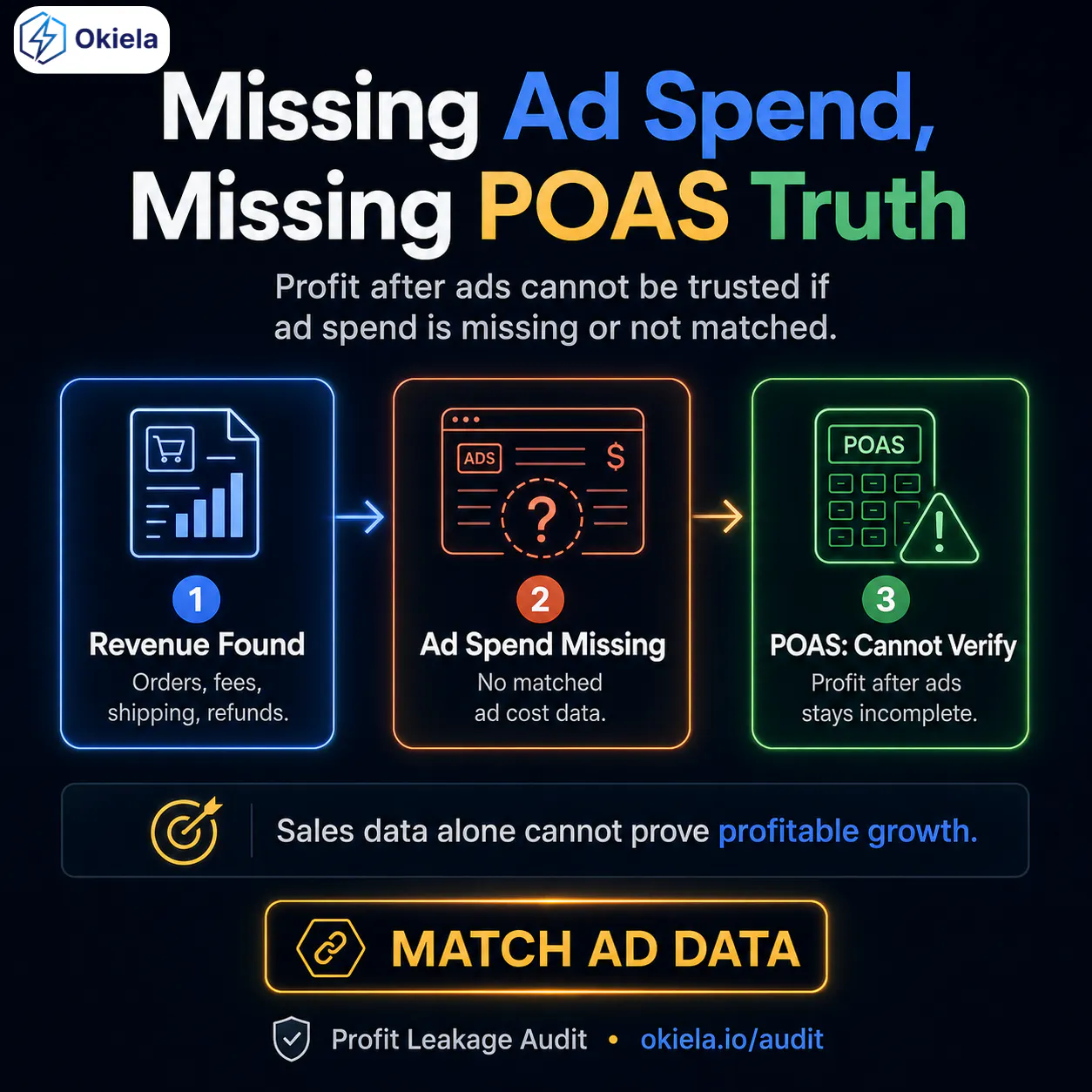
Why POAS needs ad spend data ?
Why does POAS need ad data?
Because profit after ads cannot be trusted if ad spend is missing.
Revenue tells you how much customers paid.
COGS, fees, shipping, discounts, refunds, and taxes help explain what is left before ads.
But if ad spend is not included or not matched properly, you still do not know whether the sale was actually profitable after acquisition cost.
This is where many ecommerce sellers get trapped.
A product can look profitable before ads.
A campaign can look strong by ROAS.
A channel can look healthy by revenue.
But after ad spend, the real answer may change.
That does not mean ads are bad.
It means profit needs the full cost picture.
Okiela helps sellers separate what is verified, estimated, and missing... so profit after ads is not treated like a guess.
Send one order export, get your 3 biggest profit leaks in 48h: okiela.io
#EcommerceProfit #POAS #UnitEconomics
 •
•3mo ago
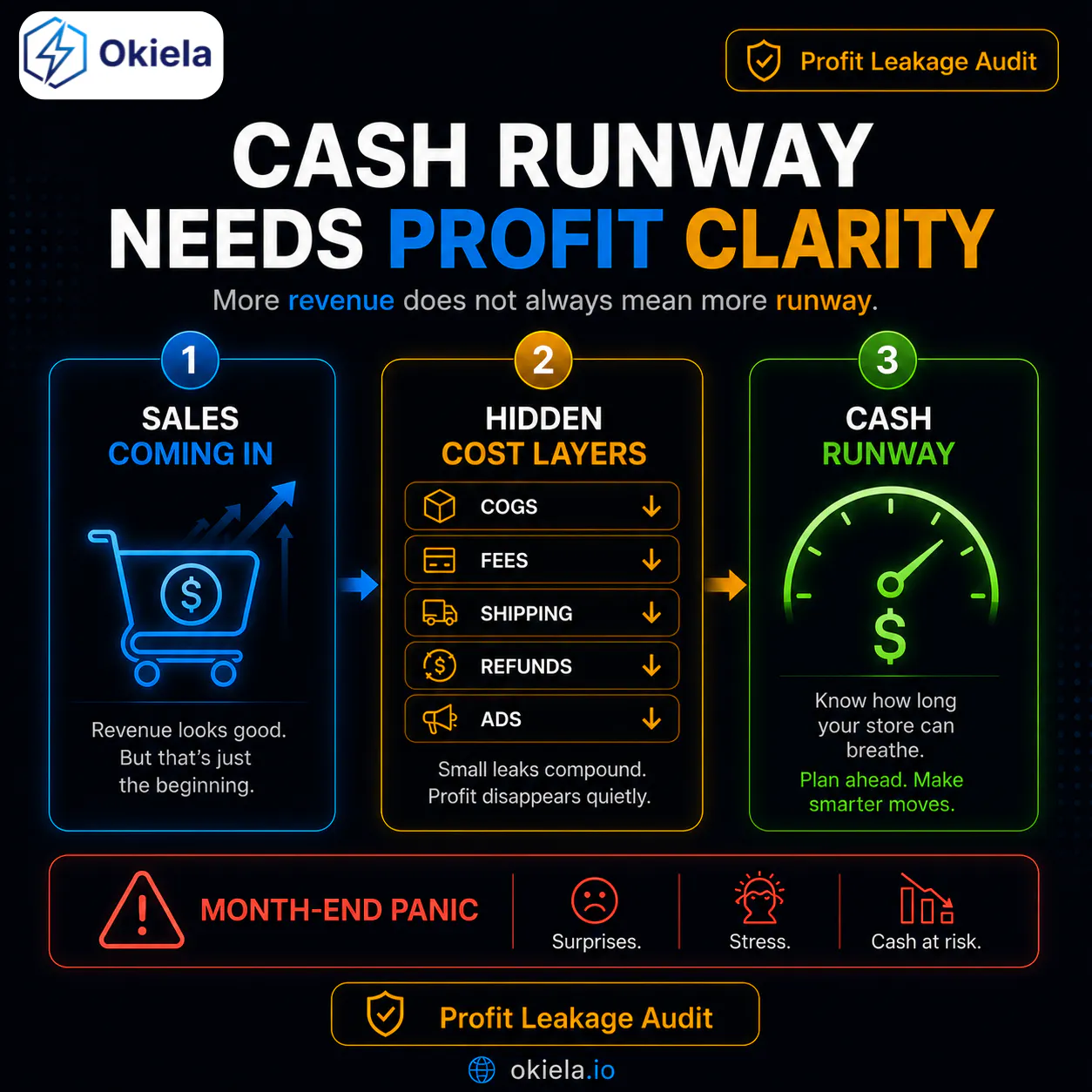
Cash runway needs PROFIT clarity
Cash runway needs profit clarity.
For ecommerce sellers, more revenue does not always mean more runway.
A store can have strong sales activity and still feel cash-tight because revenue passes through many cost layers before it becomes usable cash:
COGS
payment fees
platform fees
shipping costs
refunds
discounts
ad spend
inventory timing
supplier payments
This is why revenue alone is not enough for operating decisions.
Revenue shows what came in.
Profit clarity shows what the store actually keeps.
And runway depends on what the store can actually use.
Before scaling ads, reordering inventory, extending a discount, or cutting costs, ecommerce operators need to understand which products, orders, and cost layers are quietly draining margin.
Okiela helps ecommerce sellers find hidden profit leaks by SKU, order, and channel.
Find the hidden profit leaks draining your store. Send one order export and get your 3 biggest profit leaks in 48h: okiela.io/audit
#EcommerceProfit #Shopify #DTC #Okiela