
 •
•3mo ago
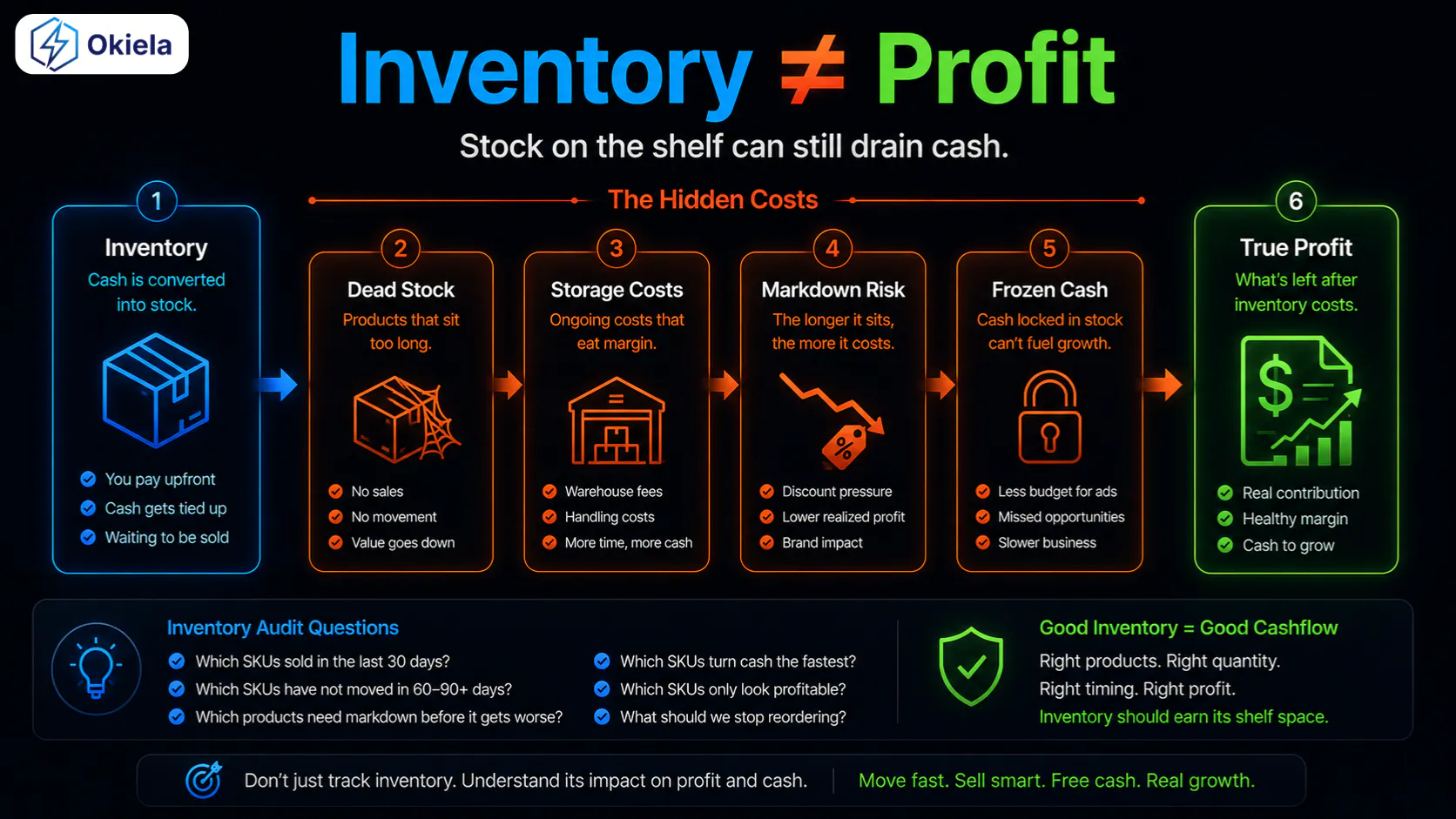
Sales can look great...Inventory can still be quietly eating the business. ..That is the weird part.
... A product can sit on the shelf and not look like a loss yet.
No refund.
No chargeback.
No angry customer.
No obvious red line in the dashboard.
But it is still costing you.
Cash is tied up.
Storage keeps running.
Products age.
Trends move.
Markdown pressure builds.
The money cannot be used for ads, faster SKUs, or new tests.
Inventory is not just product.
It is cash waiting to come back.
And if it sits too long, that cash comes back smaller.
Before buying more stock, I would ask:
which SKUs sold in the last 30 days?
which ones have not moved in 60 90 days?
which products need markdowns before they get worse?
which SKUs turn cash quickly?
which SKUs only look profitable because holding cost is ignored?
A slow-moving product with decent margin can still hurt the store.
Because margin does not matter much if the cash is trapped for months.
Sales tell you what moved.
Inventory tells you where your cash is stuck.
You need both.
----
I'm asking a few shop owners to try it and tell me what's off. Want to give it 60 seconds? => Detail: okiela.io/audit
or send me your export and I'll hand-check your 3 biggest profit leaks in 48h, free. No pitch, I just need to learn from real shops.
 •
•3mo ago
Not every abandoned cart needs a discount....This sounds small...But it can protect a lot of margin.
...Many stores accidentally teach customers the same habit:
Add to cart.
Leave.
Wait.
Get coupon.
Buy later.
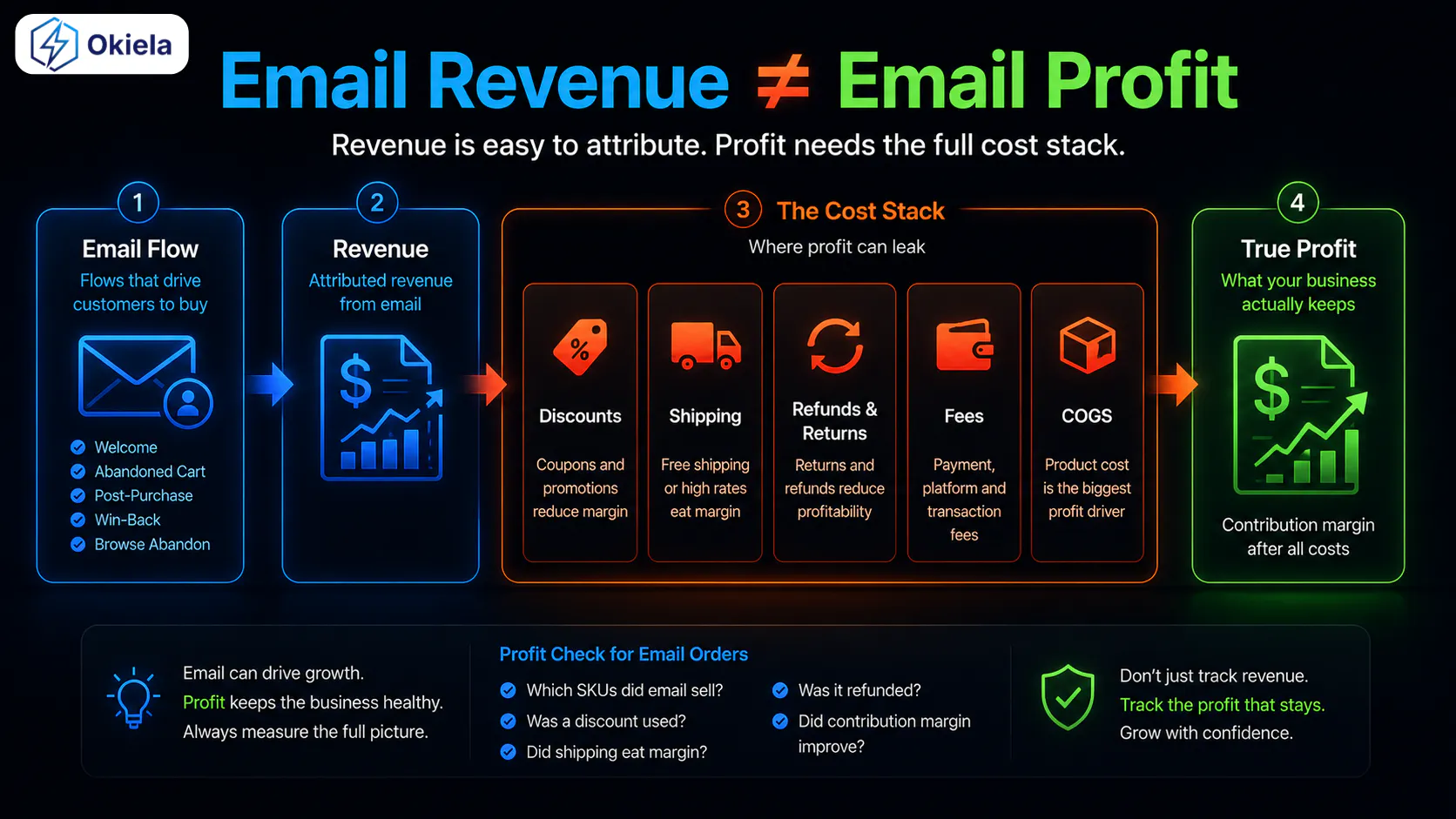
The flow recovers revenue.
But it may also train discount behavior.
That is why I think the first abandoned cart email should not always lead with a coupon.
Sometimes the buyer only needs a reminder.
Sometimes they need trust.
Sometimes they need shipping clarity.
Sometimes they need reviews.
Sometimes they were just distracted.
A discount should answer a price problem.
Not every cart is a price problem.
Before adding a coupon, I d ask:
Is this SKU high enough margin?
Is this buyer new or returning?
Is shipping the real blocker?
Is trust the real blocker?
Would this customer buy without the discount?
A recovered cart is good.
A recovered cart with healthy margin is better.
-------
I'm asking a few shop owners to try it and tell me what's off. Want to give it 60 seconds? => Details: okiela.io/audit
or send me your export and I'll hand-check your 3 biggest profit leaks in 48h, free. No pitch, I just need to learn from real shops.
 •
•3mo ago
REVENUE can grow....PROFIT can grow....And CASH can still get tighter.
Revenue can grow.
Profit can grow.
And cash can still get tighter.
That is the part ecommerce founders often feel before they can explain.
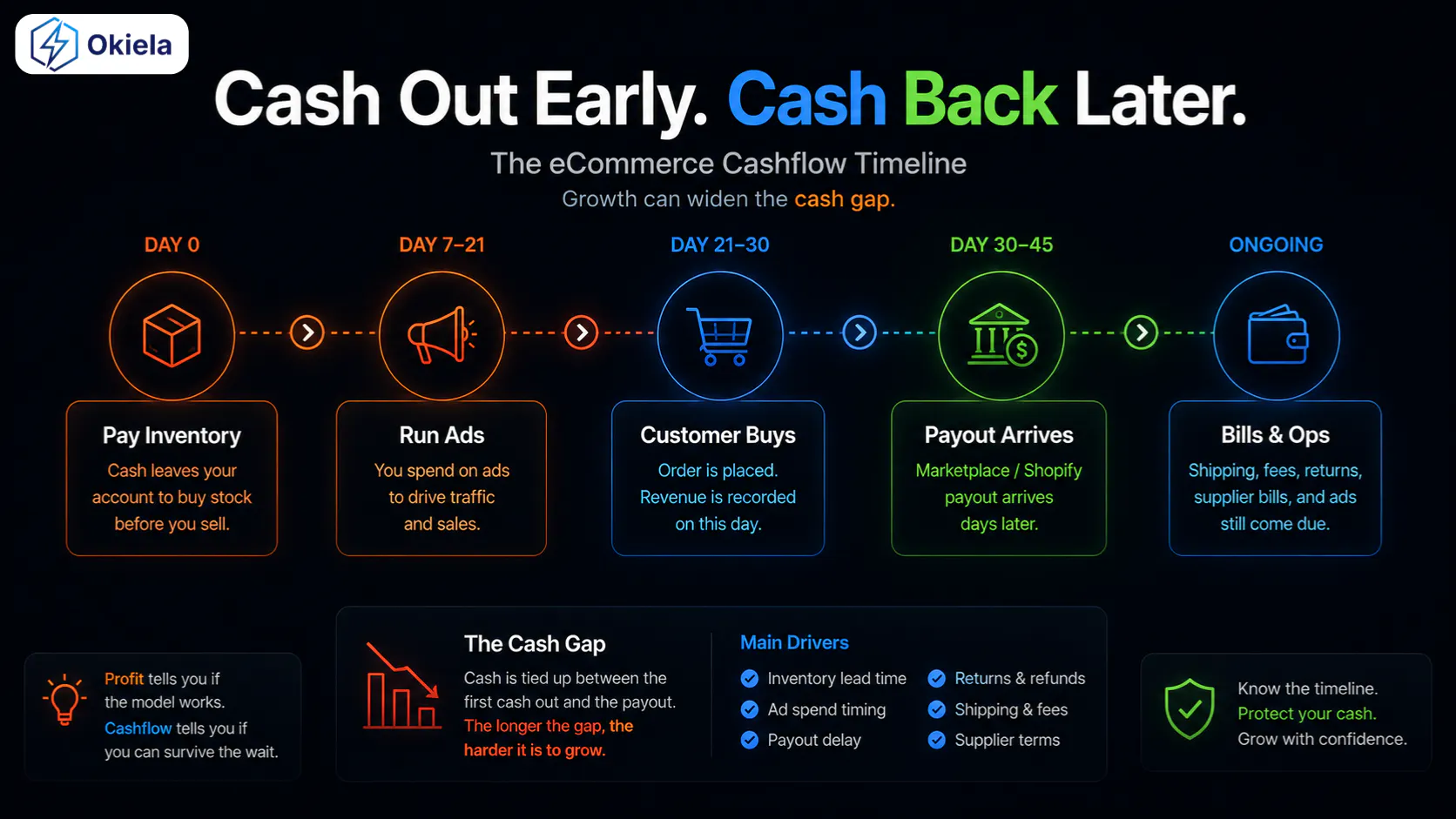
Because ecommerce has a cash timeline.
Cash usually leaves first.
Inventory is paid before the sale.
Ads are spent before or around the sale.
Shipping and fees hit the order.
The customer buys later.
The payout arrives later.
So the store may be doing well on paper.
But the bank account still feels behind.
This is why growth can be confusing.
More orders do not only mean more money coming in.
They also mean more inventory needed upfront.
More ads funded upfront.
More cash tied before the next payout arrives.
So before scaling, I would not only ask:
Are we profitable?
I would ask:
How long is our cash underwater?
A simple weekly check:
opening bank balance
expected payouts
- bills due
- inventory commitments
= projected cash position
If that number feels tight, the business has a cash timing problem.
Not always a profit problem.
Profit tells you if the order works.
Cashflow timing tells you if the business can survive the wait.
Drop your Shopify export and check your own numbers here: https://
okiela.io/try
 •
•3mo ago
Outsourcing feels like a cost.....But doing everything yourself has a cost too.
Outsourcing feels like a cost.
But doing everything yourself has a cost too.
Packing orders.
Replying to tickets.
Updating sheets.
Chasing product photos.
Checking small ops issues.
Following up with suppliers.
It can feel responsible.
But at some point, the question changes.
Not:
Can I do this myself?
But:
Is this still the best use of founder time?
That is where many ecommerce founders get stuck.
They keep low-value work close because it feels cheaper.
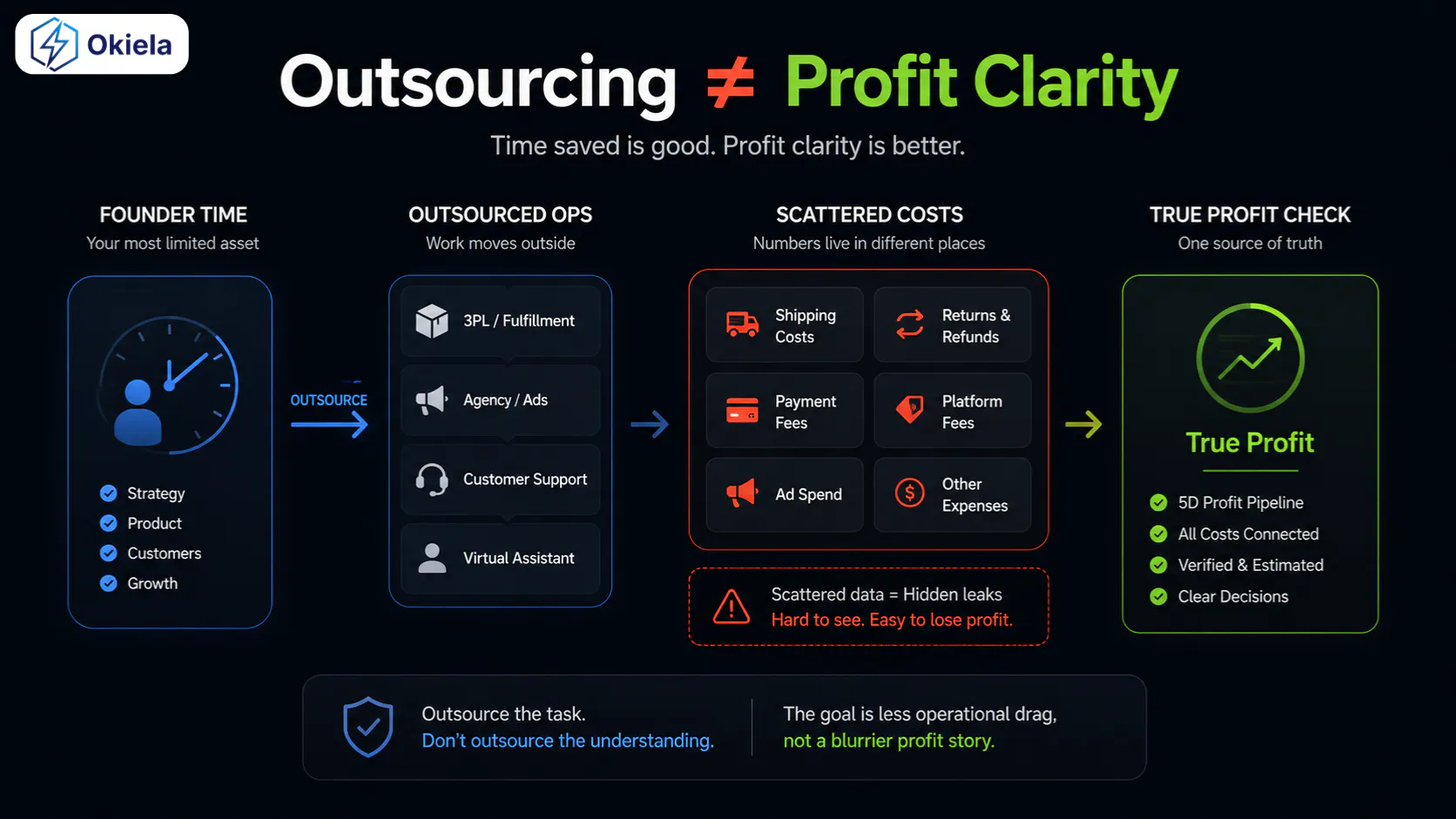
But the hidden cost is time taken away from pricing, product, customers, cashflow, and growth.
Still, outsourcing is not automatically good.
A 3PL can reduce fulfillment pressure.
An agency can move faster.
A VA can clear repetitive work.
But once work moves outside the business, the numbers often get harder to connect.
Shipping lives in one place.
Returns in another.
Ad spend somewhere else.
COGS in a sheet.
Invoices come later.
So the real rule is:
Outsource the task.
Do not outsource your understanding of the business.
Before outsourcing, ask:
what does this task cost in time?
can someone else do it repeatedly?
what quality risk appears?
how will I measure the impact?
will profit become clearer or more blurry?
The work can move outside.
Profit clarity should stay close.
#ecommerce #shopify #profitability #Okiela
 •
•3mo ago
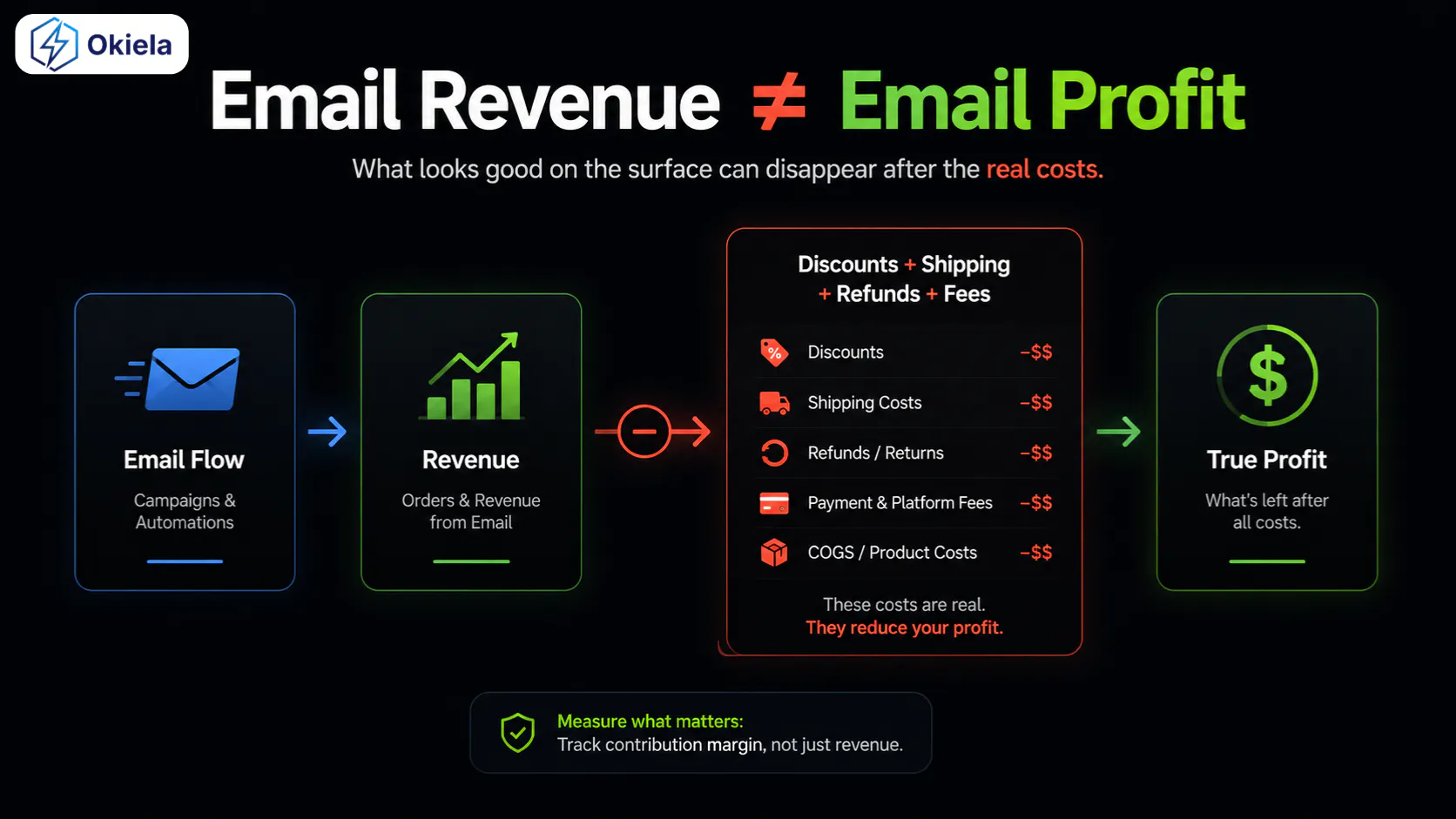
Using email flows but unsure if they’re actually profitable?
Email ROI can look almost too good.
$36 back for every $1 spent.
Sometimes more.
But for ecommerce founders, I think the better question is not:
How much revenue did email drive?
It is:
How much profit did email leave behind?
Because an email flow can look great in Klaviyo.
Then you check the order:
discount applied
free shipping
low-margin SKU
payment fees
refund risk
COGS
ad attribution overlap
And suddenly the email revenue story gets thinner.
Email is powerful because it usually does not need a new paid click.
But it still needs profit math.
A win-back flow that brings back customers with a heavy discount may recover revenue.
But if the customer buys a low-margin item and returns it later, the dashboard may celebrate too early.
The simple check:
email revenue is useful.
email profit is better.
Before calling a flow successful, I d ask:
Which SKUs did it sell?
Was there a discount?
Did shipping eat margin?
Was the order refunded?
Did contribution margin improve?
Email is not just a retention channel.
It is a profit channel only if the numbers survive after the sale.
#ecommerce #shopify #retention #Okiela
 •
•3mo ago
Find profit leaks before seasonal campaigns
Q4 revenue can look amazing.
Then January tells the truth.
A store can have its biggest sales month of the year and still walk away with less profit than expected.
Not because the founder is careless.
Because seasonal sales bring hidden pressure:
discounts
rushed shipping
higher ad costs
extra labor
inventory mistakes
returns that arrive later
That is the trap.
Most seasonal plans start with:
How much can we sell?
I think the better first question is:
Which sales are safe to create?
A Black Friday order is not automatically good because revenue went up.
If the SKU has weak margin, shipping is subsidized, ad costs are higher, and January returns come back, that order may be much weaker than it looked.
Seasonal planning should not be only a marketing calendar.
It should be a profit plan.
Before Q4, I would check:
which SKUs can handle a discount
which SKUs should stay full price
which shipping offers are safe
how much cash is needed before revenue arrives
what happens if returns hit in January
Revenue is the loud number.
Profit is the number that decides if the season was actually worth it.
Send one order export, and I ll send back the 3 biggest profit leaks I can find within 48 hours.
Every number is labeled [VERIFIED] or [ESTIMATED].
•3mo ago
A 12% margin can be great....Or average....Or a warning sign.
A 12% margin can be great.
Or average.
Or a warning sign.
That is the annoying part about ecommerce benchmarks.
They only make sense when you compare against the right category, store size, and cost structure.
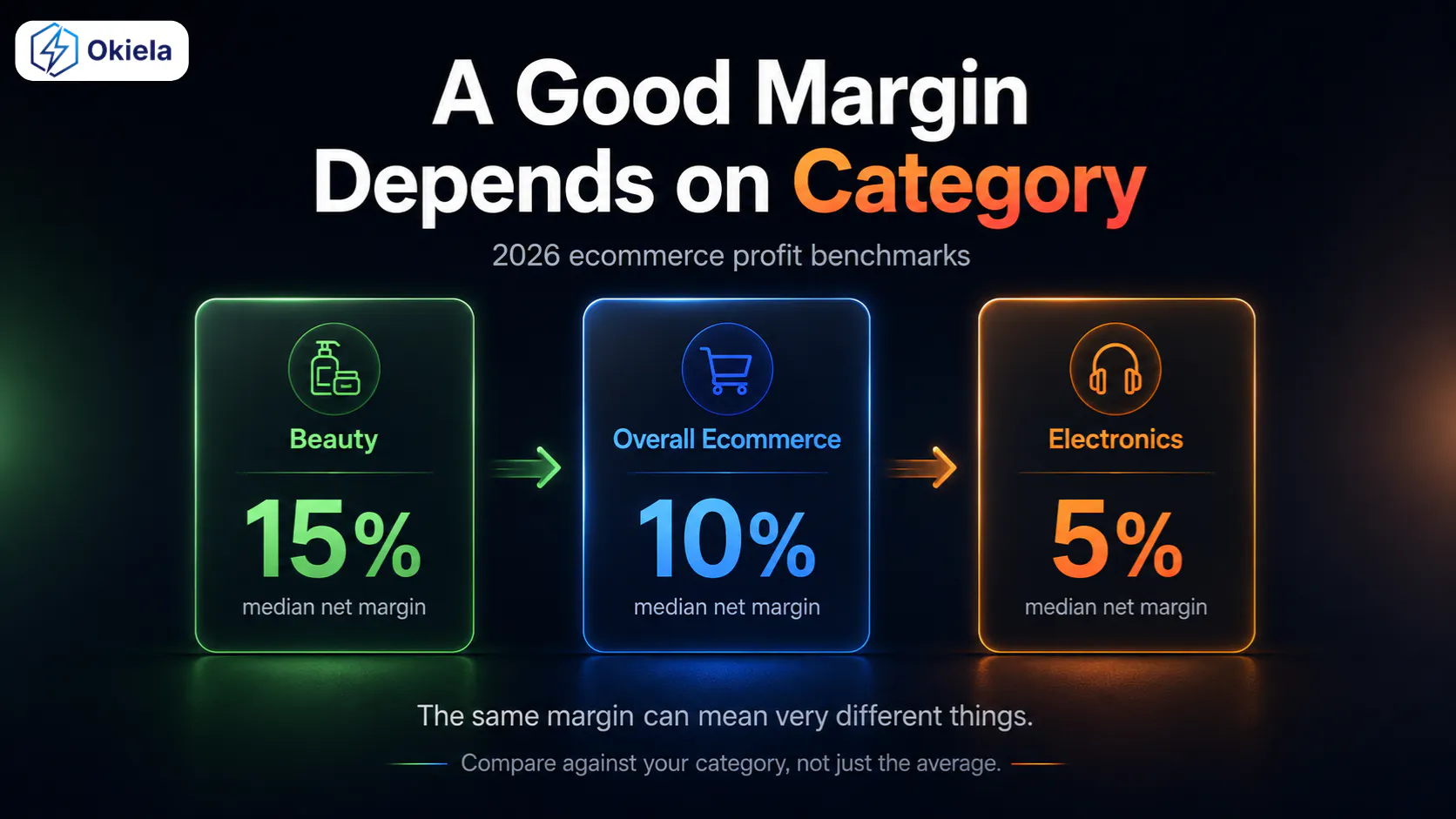
A beauty brand with 12% net margin may still have room to improve.
An electronics brand at 12% may be doing very well.
An apparel store at 12% might look healthy until returns start changing the story.
So the better question is not:
Is my margin good?
It is:
Good compared to what?
Category matters.
Store size matters.
Channel mix matters.
Return rate matters.
COGS matters.
Shipping matters.
Ad spend matters.
That is why I like benchmarks as a map, not a scorecard.
They should not make founders feel good or bad.
They should help answer:
where should I look first?
Maybe your COGS is too high.
Maybe shipping is quietly pulling margin down.
Maybe your return rate is normal for your category.
Maybe your ad spend looks fine overall, but one SKU is doing all the damage.
The real value is not knowing the average.
The value is finding your own gap.
Drop your Shopify export into Okiela and see where your store sits.
Free. No signup. About 30 seconds.
https://okiela.io/try
#shopify #ecommerce #profitability #Okiela
 •
•3mo ago
Find which SKUs can be bundled profitably
A bundle can make your Shopify store look smarter.
Or it can quietly turn into a discount pile.
That is the part many founders miss.
A good bundle is not just:
buy these 3 things and save money.
A good bundle answers a real buying moment.
A first-time customer who does not know what to choose.
A repeat customer who needs a refill.
A gift buyer who wants convenience.
A slow-moving SKU that needs help.
A customer who wants the complete solution, not one random item.
That is why bundle profit is not only about AOV.
AOV can go up while margin gets weaker.
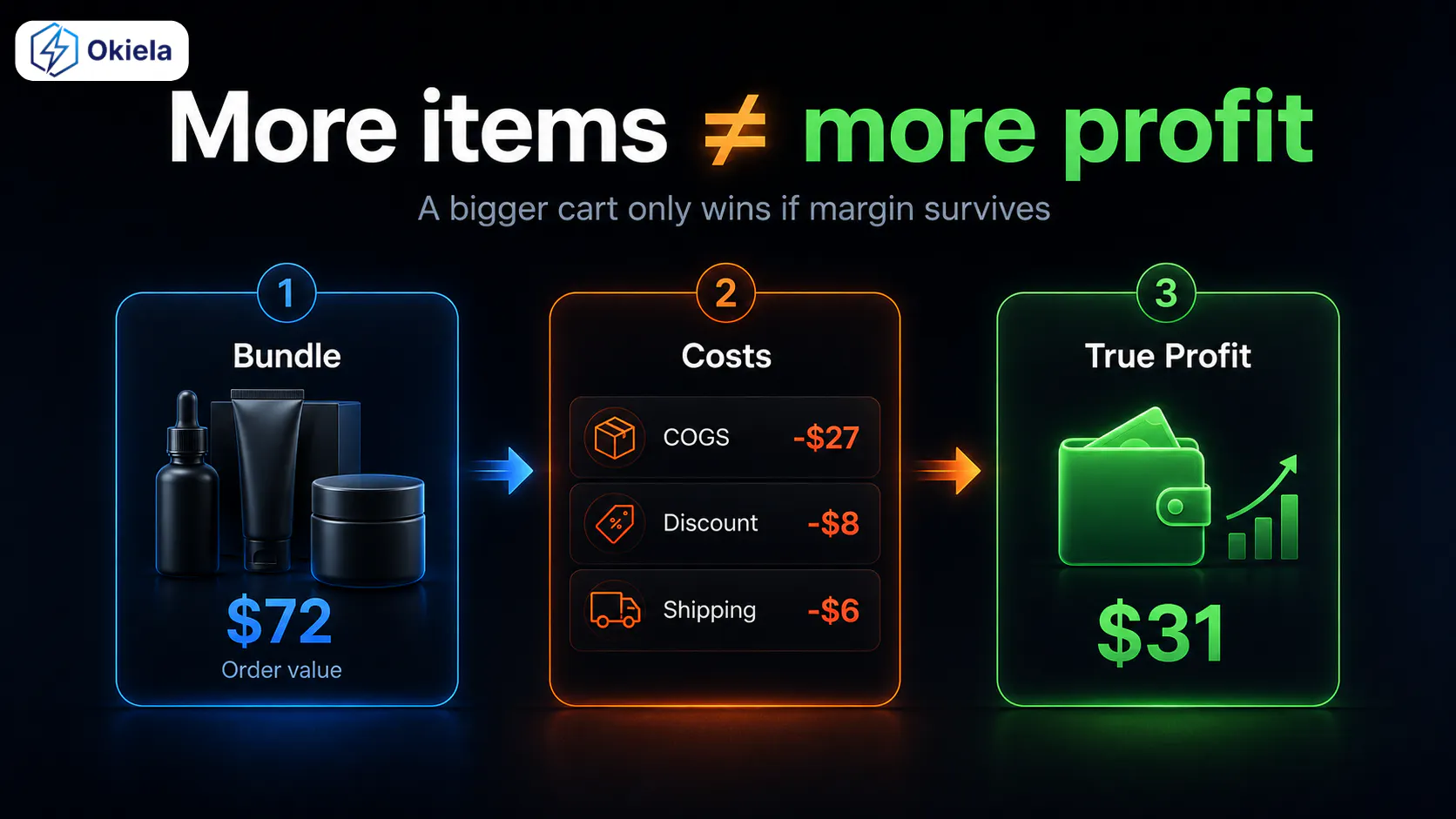
Simple example:
You bundle 3 products.
Revenue looks better.
The order value is higher.
Nice.
But then you check:
COGS
shipping
fees
discount
return risk
And suddenly the bundle is not as strong as it looked.
Before creating a bundle, I d ask one quiet question:
does this bundle create more profit, or just a bigger cart?
That is the difference.
The blog goes deeper into the 5 bundle types and the pricing math.
But the fastest way to start is simple:
take your own Shopify export,
drop it into Okiela,
and check which SKUs have enough margin room to be bundled safely.
Free. No signup. About 30 seconds. Data stays in your browser.
Drop your Shopify export and check your own numbers here:
https://okiela.io/try
Full guide is on the Okiela blog if you want to go deeper.
#shopify #ecommerce #profitability #Okiela
 •
•4mo ago
Pricing psychology can help people buy...But it cannot save weak economics.
Pricing psychology can help people buy.
But it cannot save weak economics.
That is the part ecommerce founders need to be careful with.
A price ending in .99 may feel lighter.
A crossed-out price may create an anchor.
A bundle may make the offer easier to understand.
A free shipping threshold may increase AOV.
A discount may create urgency.
All of that can work.
But here is the uncomfortable part:
a better-looking price is not always a better business decision.
If the price improves conversion but quietly destroys contribution margin, the store may look healthier on the surface while profit gets thinner underneath.
That is why I think pricing psychology should never be separated from unit economics.
Before changing price, I would ask:
Does this price still protect gross margin?
Does this discount still work after shipping and fees?
Does the bundle improve profit or just revenue?
Does free shipping increase AOV enough to cover the cost?
Does this price attract better customers or only more low-margin orders?
The goal is not to trick customers.
The goal is to reduce friction while keeping the economics healthy.
Good pricing should feel easy for the customer and still make sense for the business.
That is where the real work is.
Not just:
What price gets more clicks?
But:
What price creates profitable orders?
That small shift changes a lot.
Full post: https://okiela.io/blog/pricing-p...
#ecommerce #shopify #pricingstrategy #profitability #dtc #unitEconomics #Okiela
 •
•4mo ago
One thing I think ecommerce founders should look at earlier:...COGS negotiation.
Not because every supplier should be pushed for a lower price.
But because COGS quietly decides whether growth actually turns into profit.